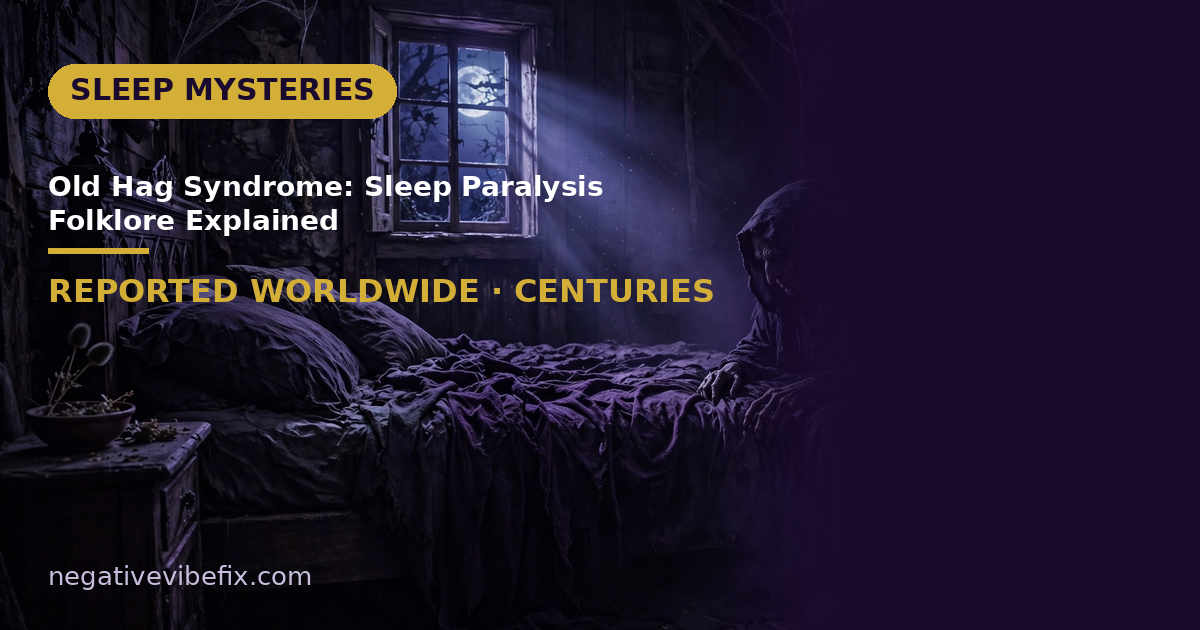
Last updated: October 23, 2026 • By NegativeVibeFix
Is the Old Hag dangerous? Old hag syndrome is the traditional name for what sleep science calls sleep paralysis: a brief, frightening glitch where your mind wakes before your body does. It can’t hurt you physically, episodes pass within minutes, and the “hag” is a hallucination your half-dreaming brain invents to explain the paralysis.
- c. 2000 BC — earliest written accounts of the phenomenon, in Mesopotamian texts about the demon Lilitu
- 1664 — first clinical case recorded by Dutch physician Isbrand van Diemerbroeck
- 1781 — Henry Fuseli paints The Nightmare, the most famous artistic depiction of the experience
- 1890s — the Journal of American Folklore documents the “Old Hag” belief in Newfoundland
- 100+ — distinct cultural names for sleep paralysis identified by researchers worldwide
- Seconds to minutes — typical length of an episode before movement returns on its own
What is old hag syndrome? It is the folk name — rooted in Newfoundland and wider British folklore — for sleep paralysis: waking up unable to move, often with a crushing sensation and vivid hallucinations of a figure pressing down on you.
Is Old Hag Syndrome Dangerous?
No — terrifying, but not dangerous in itself. During an old hag syndrome episode you’re conscious but temporarily unable to move or speak. The experience feels like being pinned down by a malevolent presence, but no physical harm occurs.

The one real risk is the fear itself: repeated episodes can make people dread bedtime. See our article on the sleep paralysis demon and why you see a figure for the science of the visions.
Who Is the Old Hag?
In the folklore, the Old Hag is a nightmare spirit: a crone-like old woman who slips into bedrooms at night and sits on sleepers’ chests, pinning them down. The belief connects to the Old English mæra and the Scandinavian mara, and our word “nightmare” comes straight from this belief: the night-mare, a spirit that pressed down on sleepers. The Old Hag is simply the English-speaking world’s version of a near-universal figure.
Where Did the Name “Old Hag Syndrome” Come From?
The name traces to Newfoundland: in the 1890s, the Journal of American Folklore documented the local belief in the “Old Hag” — a witch-like entity blamed for the crushing nighttime experience.

But the story is far older than the name: Mesopotamian texts from around 2000 BC describe the demon Lilitu pressing down on sleepers, and Henry Fuseli’s 1781 painting The Nightmare is now read as a direct portrait of a sleep-paralysis hallucination.
Why Do Some People Call It Old Hag Syndrome?
Because the name stuck where the folklore was strongest. The Journal of American Folklore’s 1890s accounts from Newfoundland gave researchers a label, and “old hag syndrome” entered both popular and clinical discussion as shorthand for the folklore-framed experience.
The Same Terror in Every Culture
Researchers have catalogued over 100 cultural names for sleep paralysis. The details change; the core experience — waking paralyzed with a sensed presence — does not.
| Culture | Name | The figure / belief |
|---|---|---|
| Newfoundland | Old Hag | Crone who sits on the sleeper’s chest |
| Brazil | Pisadeira (“she who steps”) | Old woman who stamps on the chests of back-sleepers |
| Japan | Kanashibari (“bound in metal”) | Vengeful spirits pinning the body down |
| China | Gui ya chuang (“ghost pressing on the body”) | A ghost’s crushing weight on the sleeper |
| Persia | Bakhtak | Creature that sits on the chest; the word also means “nightmare” |
The same biology wearing different costumes. Compare with our pieces on false awakenings and why we sleepwalk.
South-East Asia: Phi Am, the Ghost That Sits on You
In Thai, Lao, and Cambodian culture, sleep paralysis is called phi am — in Thailand, the ghost Phi Am is said to sit on sleepers’ chests, and stories about it are widespread.
West and Central Asia: Ja-thoom, “What Sits Heavily”
In Arab folklore, the experience is called Ja-thoom — literally “what sits heavily on something” — a presence believed to pin the sleeper down.
Old Hag Syndrome: Folklore Claim vs What Science Found
| What the folklore claims | What sleep science found |
|---|---|
| A hag sits on your chest | Shallow REM breathing plus panic feels like pressure |
| She holds you down so you can’t move | REM atonia — the brain’s natural dream-safety switch |
| She comes to harm you | A half-dream hallucination; no entity, no intent |
| Sleeping on your back invites her | Back-sleeping measurably raises episode odds |
| Only the cursed are visited | Anyone with disrupted sleep can experience it |
What Does Sleep Science Say Is Actually Happening?
Sleep researchers describe old hag syndrome as a timing glitch between brain and body — and every element of the folklore maps neatly onto the biology.
What Sleep Paralysis Is — and Isn’t
Sleep paralysis is a recognized parasomnia: you regain consciousness while your body is still in REM sleep’s muscle paralysis. It is not dangerous, not supernatural, and not a sign of mental illness.
What’s Happening Biologically During Sleep Paralysis
During REM sleep your brain switches your muscles off so you don’t act out dreams. In sleep paralysis, you wake up before the “off switch” releases — leaving you conscious but temporarily paralyzed.

What Are the Symptoms of Sleep Paralysis?
The classic symptoms: inability to move or speak on waking, a feeling of pressure on the chest, intense fear, and vivid hallucinations — often of a figure in the room. Episodes typically last seconds to a few minutes.
Who Is at Risk for Sleep Paralysis?
Episodes are more likely with irregular sleep schedules, stress, alcohol use, and sleeping on your back. Students, shift workers, and people with sleep disorders report them most often.
Sexual Abuse Survivors and Sleep Paralysis: A Responsible Note
Research has found that survivors of sexual abuse and people living with PTSD report sleep paralysis more often — and the hallucinations can be especially distressing. If episodes connect to trauma, a trauma-informed therapist can help more than any folklore explanation.
What to Do During an Episode (and When to See a Doctor)
If it happens tonight: don’t fight the paralysis — struggling spikes panic. Focus on wiggling a finger or toe, and slow your breathing. The episode will pass on its own within minutes.

To cut future episodes: keep a consistent sleep schedule, sleep on your side, limit alcohol and late caffeine, and manage stress. See a sleep specialist if episodes are frequent, severely distressing, or come with excessive daytime sleepiness (which can signal narcolepsy).
Practice Good Sleep Hygiene
The least dramatic fix is the most effective: a consistent bedtime and wake time, a cool dark bedroom, no screens before bed, and no alcohol or heavy meals late at night.
Consider Cognitive Behavioral Therapy (CBT)
For recurring episodes, sleep specialists often recommend cognitive behavioral therapy for insomnia (CBT-I), which addresses the anxiety and sleep disruption that feed the cycle.
What You Can Do About Sleep Paralysis
During an episode: don’t fight it, move a finger or toe, and slow your breathing until it passes. Between episodes: regular sleep, side-sleeping, and stress management prevent most recurrences.
External sources: Sleep Paralysis — Sleep Foundation (causes, symptoms, prevention); Understanding Sleep — NINDS, U.S. National Institutes of Health (how the brainstem paralyzes muscles during REM sleep).
People Also Ask About Old Hag Syndrome
Can the Old Hag hurt you?
No. The Old Hag is a hallucination produced during sleep paralysis — it has no physical form and cannot harm you. The terror is real; the danger is not.
Why do I see a figure during sleep paralysis?
Because you’re half-dreaming. REM dreams don’t stop the instant you wake, so dream fragments play out in your bedroom — and your brain builds a figure to explain the paralysis.
Is it bad to sleep on your back if I get sleep paralysis?
Back-sleeping is linked to more frequent episodes, and folk wisdom figured this out long before science did. Try side-sleeping to reduce them.
How long does an old hag syndrome episode last?
Usually seconds to a few minutes. Movement returns on its own as your brain fully exits REM sleep. If episodes are very frequent or distressing, see a sleep specialist.
Old Hag Syndrome FAQ
Q: Is the Old Hag dangerous?
A: The Old Hag is folklore’s name for sleep paralysis, a harmless — though terrifying — glitch where your mind wakes before your body. No entity, no intent, no physical danger.
Q: Why do I feel something sitting on my chest during sleep paralysis?
A: The crushing sensation comes from shallow breathing during REM sleep combined with panic. Your brain invents the “hag” to explain why you can’t move.
Q: How do I stop old hag syndrome episodes?
A: Sleep on your side, keep a regular sleep schedule, and reduce stress and alcohol. During an episode, wiggle a finger or toe and breathe slowly until it passes.
Q: Where does the name Old Hag syndrome come from?
A: The name comes from Newfoundland folklore, documented in the Journal of American Folklore in the 1890s — though the belief itself dates back millennia.
More Sleep Mysteries stories:
- Sleep Paralysis Demon: Why You See a Figure
- Exploding Head Syndrome: Causes and Experiences
- False Awakening: Dreaming You Woke Up, Explained
This article presents traditional beliefs and folklore for informational purposes only, not as proven fact. If you experience persistent distress, please consult a qualified professional.