Last updated: October 23, 2026 • By NegativeVibeFix
Does saging your house clear negative energy, or is it just a wellness trend? Honest answer: no study can measure “negative energy” — but a proper cleansing ritual changes how a home feels, and that matters. Here’s how to sage your house: what to buy, the exact 6-step sequence, and when not to do it.
- 94% — a 2007 Journal of Ethnopharmacology study reported medicinal smoke cut airborne bacteria by 94%.
- 15–20 seconds — burn time before blowing out the flame so the sage smolders.
- 3 sages most used for home cleansing: white sage (Salvia apiana), blue sage (Salvia azurea), garden sage (Salvia officinalis).
- 20–30 minutes — unhurried time for a full house smudging.
What is smudging? Smudging is the practice of burning dried medicinal herbs — most famously white sage — and using the smoke to cleanse a space. Plants in the Salvia family have been burned in healing ceremonies and rituals since ancient times; practitioners believe the smoke clears stagnant or negative energy.
Does Saging Your House Actually Work for Negative Energy?
Yes and no — you deserve the straight answer. Science can’t detect “negative energy” as a measurable thing. But two real effects make the ritual worthwhile.
First, the smoke does physical work. A 2007 study in the Journal of Ethnopharmacology found that medicinal smoke from traditional havan-style burning cut airborne bacteria by 94% (PubMed: 17913417). That’s not “energy,” but it is cleaner air in a literal sense.
Second, the ritual reorganizes your head. Smudging forces you to walk every room slowly, set an intention, and pay attention to your space. So treat smudging as traditional practice plus practical action — the combination is what makes it work. Our guide to removing negative energy from home covers everything else.
What Do You Need to Sage Your House Safely?
You need just a few things:
- Dried white sage bundle (Salvia apiana) — buy from a Native-owned shop or nursery-grown source, not unknown wild-harvested bundles.
- A fireproof bowl or abalone shell to catch ash and hold the smoldering bundle.
- Long matches or a lighter — long matches keep your fingers clear of the flame.
- A feather or hand fan (optional) to direct smoke; your hand works fine too.
- Open windows — one per room. Smoke and energy both need an exit path.
Blue sage is a gentler-scented alternative. If anyone has asthma or smoke sensitivity, a homemade spiritual protection spray gives you the ritual without smoke.
How Do You Sage Your House, Step by Step?
Follow this exact sequence. Slow beats fast — give it 20 to 30 unhurried minutes.
Step 1 — Set your intention. Before lighting anything, decide what you’re clearing: “I’m releasing this week’s tension.” The smoke carries the intention.
Step 2 — Open the windows and doors. One window per room gives the smoke somewhere to go. Non-negotiable for safety, not just ritual.
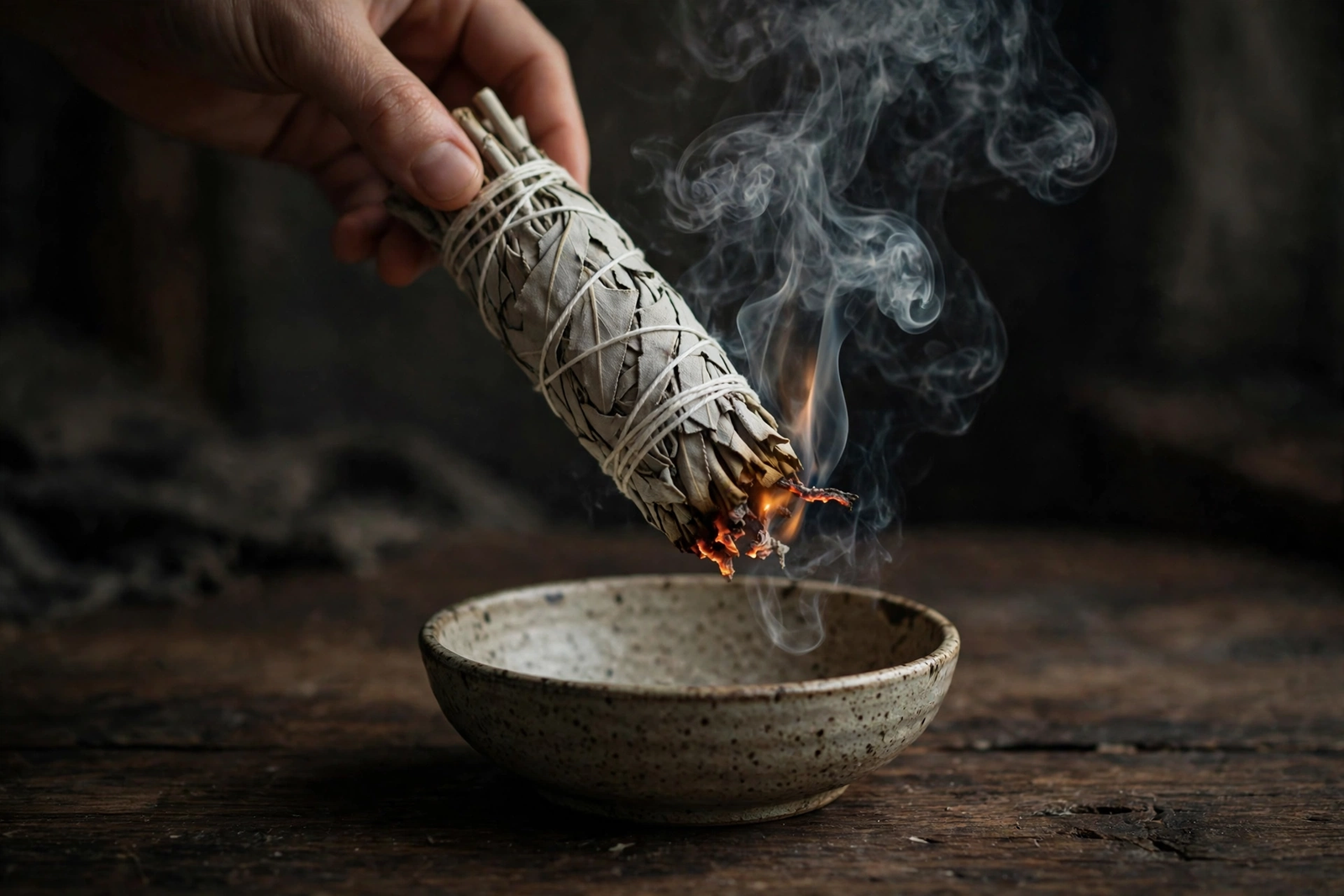
Step 3 — Light the bundle. Hold it at about 45 degrees, light the tip, let it burn 15–20 seconds, then blow out the flame until it smolders.
Step 4 — Walk every room. Start at your front door and move through the house in one direction. Waft smoke into corners, across doorways, and around windows.

Step 5 — Speak as you go. Repeat your intention in each room, out loud. “Only calm stays here” works fine.
Step 6 — End at the start. Come back to your front door, press the burning tip firmly into your fireproof bowl or sand until no ember remains.

How Often Should You Sage Your House?
For a new home, once is usually enough to clear the residue and set your own tone. After that, sage when the house feels heavy — after arguments, illness, guests who drained you, or a run of bad luck. Monthly is plenty for most homes; weekly only if the household is going through a rough patch.
Is Smudging Disrespectful? The Cultural-Roots Question
Smudging comes from Native American spiritual traditions — the Chumash, Lakota, Navajo, and other nations burned sacred herbs in ceremony long before it became a wellness trend. That history deserves respect, and how you do it counts. Learn the roots, buy nursery-grown bundles or from Native-owned suppliers (wild white sage is overharvested), and treat it as a practice you’re borrowing with gratitude — not a product you bought.
Can You Sage Yourself and Objects, Not Just Rooms?
Yes — the same smoke works on people and things. To sage yourself: cup the smoke with your hand or a feather and waft it over your body, head to feet. People do this when they feel drained after a rough day, before a big event, or after being around someone difficult. Objects — new crystals, secondhand furniture, gifts with odd vibes — get the same treatment: pass them through the smoke with intention.
What Do You Say While Smudging?
Say your intention out loud in plain words. “I’m releasing the stress this week brought in” or “Only calm stays here” both work. Some people read a short prayer or blessing from their own tradition; others stay silent and let the walking itself be the prayer. There’s no magic phrase — clarity of intent matters more than wording.
When Should You Sage — and When Should You NOT?
Sage when: after moving into a new home — to clear the emotional residue left behind by previous tenants or owners; after conflict, grief, or illness in the house; when the space just feels “off.”
Do NOT sage when: anyone home has asthma, COPD, or smoke sensitivity (try a salt-in-corners ritual instead); you’ve been drinking or are distracted; kids or pets are roaming near the bundle; or windows can’t be opened.

Sage Smudging Safety Checklist
- Always hold the bundle over a fireproof bowl — embers drop more than you’d think.
- Never set a lit bundle down on wood, paper, or fabric.
- Keep a small bowl of sand nearby; it kills embers instantly.
- Don’t inhale the smoke deeply on purpose — let it drift.
- Tamp out every ember when finished, and check again after 10 minutes.
- Store unburned bundles away from kids and heat sources.
Smoke is still smoke. Experience Life’s guide puts it well: if anyone in the home has respiratory issues, a spray alternative is the smarter move.
How Do You Extinguish and Store Your Sage Bundle?
Press the burning tip firmly into sand or a fireproof bowl until every ember is out and no smoke rises. Don’t trust it — check again after 10 minutes. Store unburned bundles somewhere cool and dry, away from kids and heat sources. You can reuse the same bundle for several smudgings until it’s too short to hold safely.
White Sage vs Palo Santo vs Cedar
Shops sell several “smudge” options. The quick comparison:
| Herb/Wood | Tradition | Scent & smoke | Best used for |
|---|---|---|---|
| White sage (Salvia apiana) | Native American ceremonial | Strong, earthy, heavy smoke | Deep clearing after conflict or heaviness |
| Blue sage (Salvia azurea) | New-world folk use | Softer, lighter smoke | Gentle blessing, welcoming positive energy |
| Palo santo | South American (Quechua) tradition | Sweet, woody | Sealing in calm after a clearing |
| Sweetgrass | Native American tradition | Gentle, sweet scent, light smoke | Inviting peace and positive energy after a sage clearing |
For a beginner doing a full house smudging, white sage remains the standard pick — blue sage is the gentler alternative.
People Also Ask
Can you sage your house at night?
Yes. There’s no rule against night smudging — daytime is popular simply because you can see the smoke drift and spot embers more easily.
How long does saging your house last?
There’s no fixed duration; it depends on what happens at home afterward. Most people re-sage after arguments, illness, or when the space starts feeling heavy again.
Does saging really remove negative energy?
No instrument can verify “negative energy,” so: not proven in a lab sense. What’s real is the 2007 finding on airborne bacteria and the genuine psychological reset the ritual provides.
Frequently Asked Questions
Q: What’s the difference between saging and smudging?
A: They’re the same act in everyday use. “Smudging” is the traditional term from Native American ceremonial practice; “saging” is the casual modern word for it.
Q: My sage bundle keeps going out. What am I doing wrong?
A: Probably nothing — loosely wrapped bundles burn out fast. Relight the tip, blow gently to feed the ember, and keep the bundle angled so heat rises into it.
More Energy Healing stories:
- How to Remove Negative Energy from Home: Guide
- How to Make Spiritual Protection Spray at Home
- Salt in Corners of Room for Negative Energy: Does It Work?
This article presents traditional beliefs and folklore for informational purposes only, not as proven fact. If you experience persistent distress, please consult a qualified professional.