Last updated: October 23, 2026 • By NegativeVibeFix
Is the kraken real? The ship-crushing sea monster is a legend — but it was probably born from something genuinely real. For centuries, Scandinavian sailors told of a colossal tentacled beast off Norway, big enough to drag down ships. Then science found the giant squid, a deep-sea creature stretching 43 feet — and the kraken legend started looking like a sailor’s exaggerated report of a real animal.
- 1646 — first written mention of the kraken in a Norwegian glossary
- 1753 — Bishop Pontoppidan publishes the most detailed early account of the creature
- 1830 — Tennyson’s poem “The Kraken” brings the legend into English literature
- 43 ft (13 m) — maximum recorded length of a real giant squid
- 2004 — first photographs of a live giant squid in its deep-sea habitat
- 27 cm — diameter of a giant squid’s eye, the largest of any animal
What is the kraken legend? It is the Scandinavian folk belief in an enormous squid- or octopus-like cephalopod of the Norwegian Sea — sometimes described as large as an island, able to drag ships under or drown them in the whirlpool of its descent.
Is the Kraken Real?
No — not as described. No evidence exists for a tentacled monster large enough to mistake for an island or sink a warship. What is real is the giant squid (Architeuthis dux): marine historians broadly agree that sailors’ encounters with this animal — or its washed-up remains — fed the kraken legend over generations.
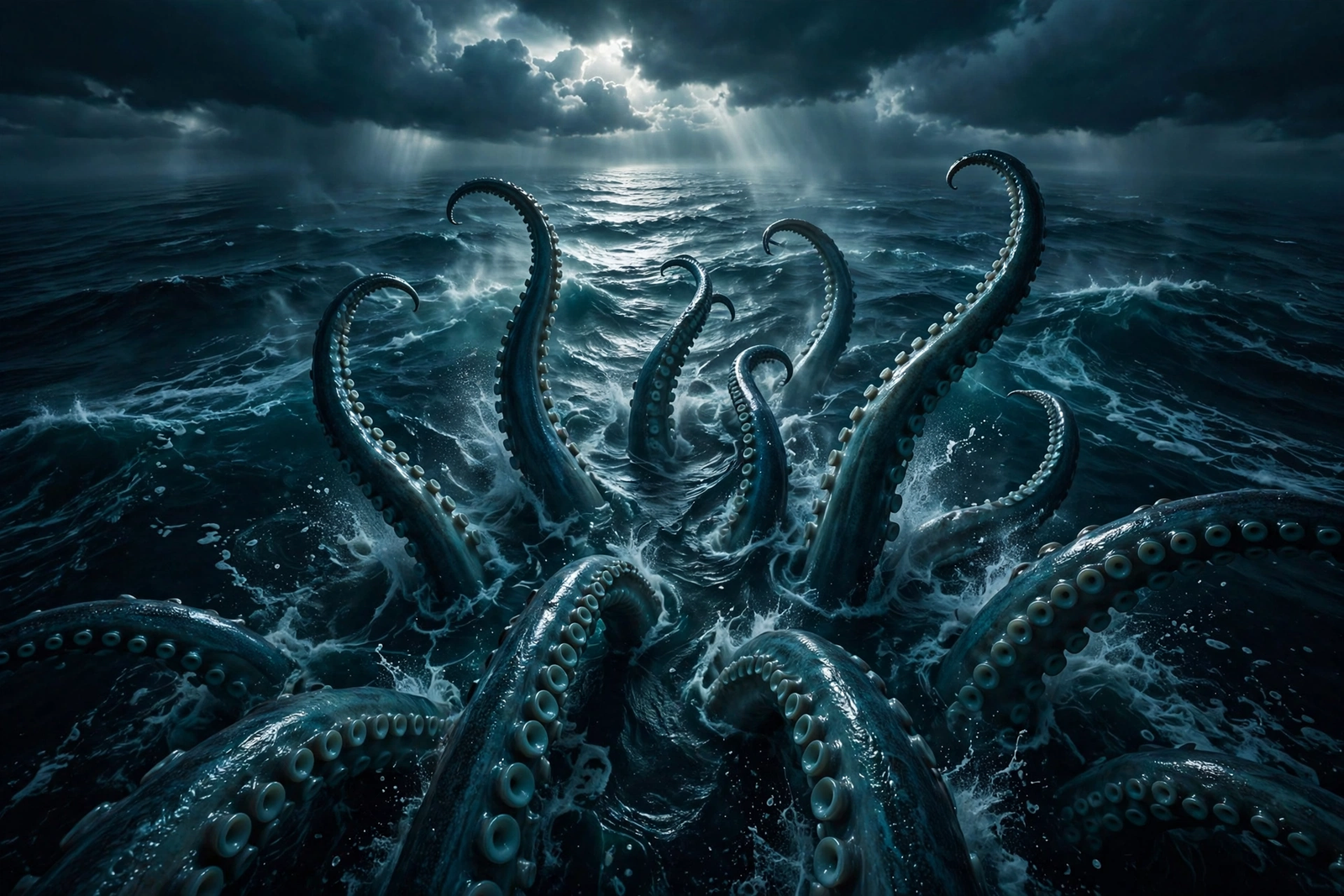
The stories weren’t baseless — a dead giant squid floating at the surface would have looked monstrous to a fisherman in 1700. The legend is folklore, but the fear behind it was earned.
Historical Descriptions: Where Did the Kraken Legend Come From?
The kraken legend grew from the North Atlantic over centuries of sailors’ reports and naturalists’ retellings. The written record is unusually detailed for a sea monster:
General Description: What the Kraken Was Said to Look Like
Early accounts describe the kraken as a colossal octopus- or squid-like creature, sometimes said to be as large as an island, with arms that could seize a ship’s masts. Its surfacing was said to pull vessels under, and its descent to leave a great whirlpool — details that stayed consistent across retellings.
Olaus Magnus (1539–1555): Sea Monsters on the Carta Marina
One of the earliest possible kraken descriptions comes from Swedish writer Olaus Magnus, whose famous Carta Marina map of Scandinavia (1539) illustrated various sea monsters — though he never used the word “kraken.” His History of the Northern Peoples (1555) carried the tradition further.
Christen Jensøn (1646): The First Written “Kraken”
The word “kraken” itself first appears in a Norwegian glossary by Christen Jensøn in 1646 — the earliest written use of the name that would define the legend.
Francesco Negri (1700): A Traveler’s Account
Italian traveler Francesco Negri mentioned the creature in a 1700 travelogue, carrying the story beyond Scandinavia to wider European readers.
Hans Egede (1734): The Missionary’s Detailed Sighting
Dano-Norwegian missionary Hans Egede described a kraken in detail in 1734, equating it with the hafgufa, a sea-monster from medieval Norse lore.
Erik Pontoppidan (1753): The Bishop’s Famous Account
Danish bishop Erik Pontoppidan published the fullest early account in his Natural History of Norway (1753), describing a tremendous octopus-like “polypus” with a reputation for pulling down ships. His version became the reference point for every retelling after.
Søren Richart Hagerup (c. 1770): The Surnadal Glossary
An anonymous glossary from Surnadal, written around 1770 and probably by Søren Richart Hagerup, described the kraken as a giant fish with tree-like fins, able to sink a whole boat.
Nordisk Familjebok (1884): The Encyclopedia’s Verdict
By 1884 the legend had cooled into reference material: the Swedish encyclopedia Nordisk familjebok summed up the kraken — “the crookie” — as a sea monster of fable and legend, not natural history.
Mythical Identifications: Hafgufa and Older Sea Beasts
Writers have long tried to match the kraken to older monsters: Egede’s hafgufa of medieval Norse lore, and even the arbor marina described by Pliny. The kraken inherited their menace and their mystery.
Taxonomic Identifications: What Science Says It Was
Modern identifications point to real cephalopods: the giant squid and its southern relative, the colossal squid. As early as 1920, scholar Finnur Jónsson argued on etymological grounds that the kraken was an “inkfish” — a squid or octopus.
Related Words: Krake, Kraken, and the “Crooked” Beast
“Kraken” is the definite form of “krake,” an old Norwegian word for a twisted or unhealthy animal — the 1884 encyclopedia glossed it as “the crookie.” The name itself records how sailors saw the beast: wrong, unnatural, alarming.
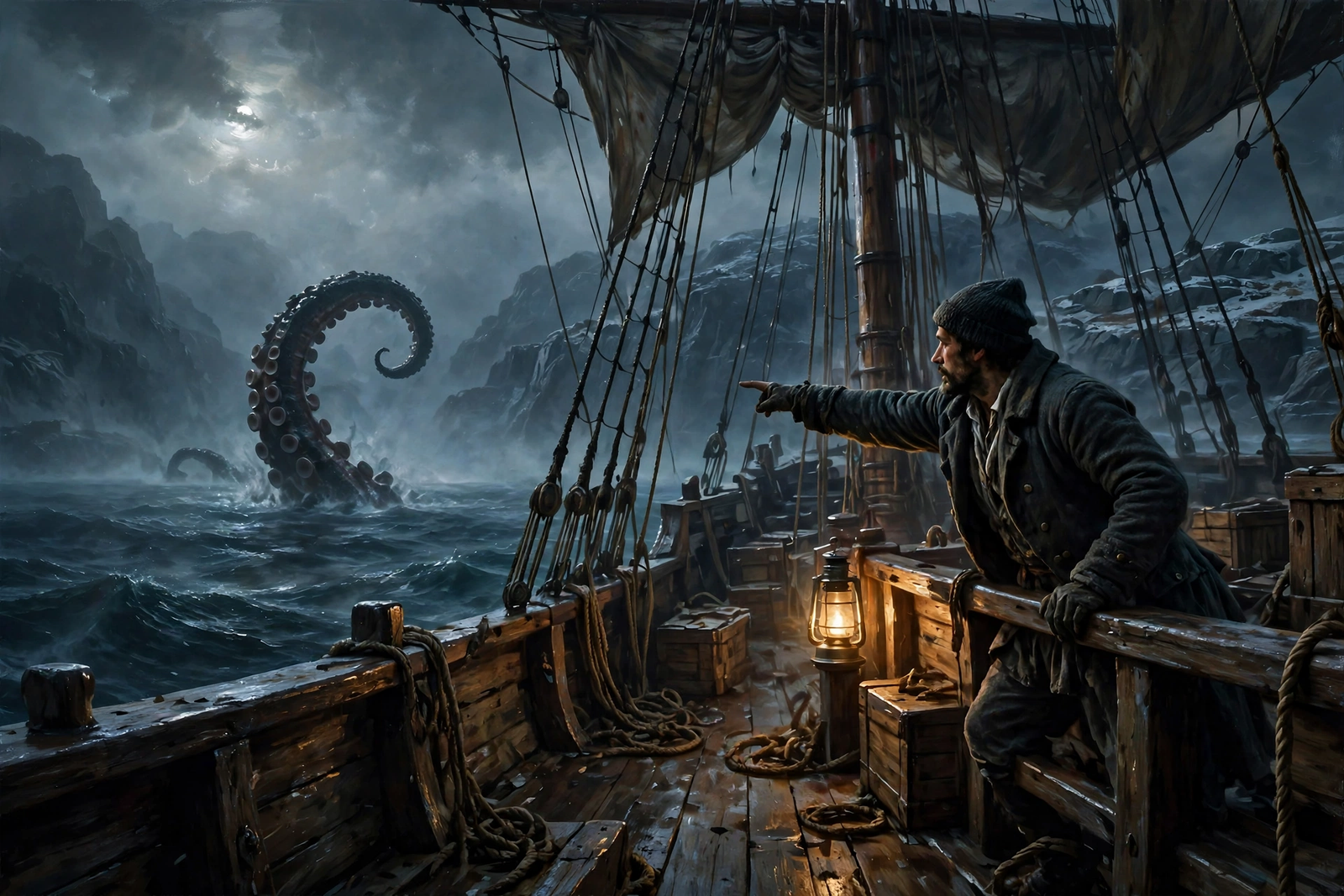
Literature made the beast bigger with each retelling: Tennyson’s 1830 poem “The Kraken,” Victor Hugo’s 1866 Toilers of the Sea, Jules Verne’s Twenty Thousand Leagues Under the Sea (1870) — the most famous fictional kraken attack, even though Verne blurred squid and octopus together. The kraken later surfaced in the 1981 film Clash of the Titans and even gave its name to Seattle’s NHL team, the Seattle Kraken. In 1801, French naturalist Pierre Denys de Montfort had already fixed the image in the public mind with his famous engraving of a colossal octopus attacking a ship.
What Did Sailors Actually See?
Probably three things, magnified by retelling: live encounters (a 30-foot squid thrashing at the surface at night would terrify anyone), carcasses washing up from Norway to Newfoundland, and sperm whales surfacing with huge circular sucker scars — proof something enormous fights them in the deep.
What Is the Real Animal Behind the Myth?
The giant squid (Architeuthis dux) lives 300 to 1,000 meters down, with eight arms plus two long feeding tentacles reaching about 43 feet end to end. Its eyes — up to 27 centimeters across, the largest of any animal — catch the faintest deep-sea light, including the glow of hunting sperm whales.
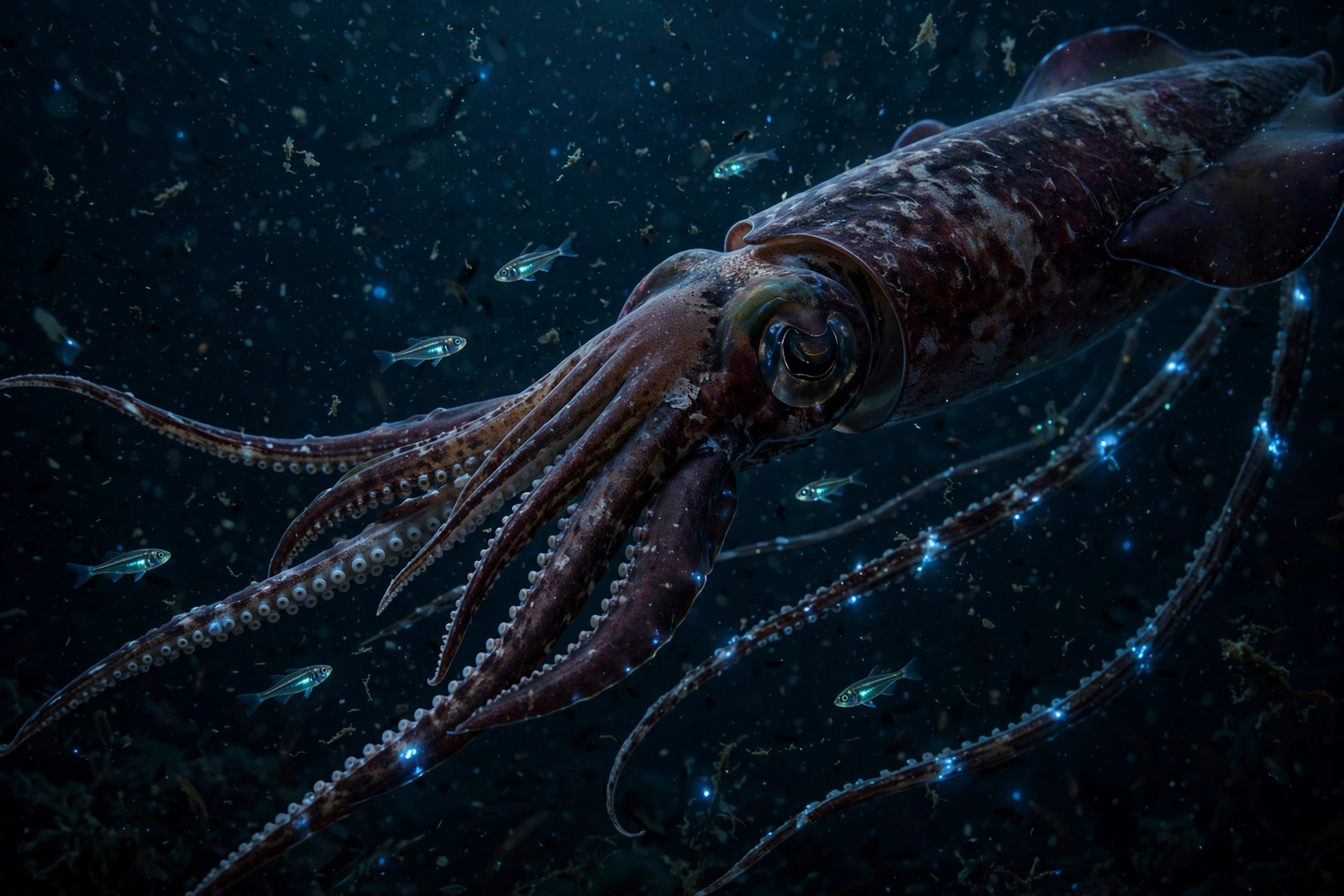
For most of history it was known only from dead specimens and whale stomachs — until 2004, when Japanese researcher Tsunemi Kubodera photographed a live giant squid in the deep sea for the first time (video followed in 2012). The unbelievable creature of the kraken legend turned out to be real — just smaller and deeper than the stories claimed. No recorded case of a giant squid attacking a ship exists; the ship-sinking is pure folklore.
Kraken vs Other Sea Monsters: How Do the Legends Compare?
Each culture dressed its own ocean fears in a sea monster:
| Monster | Origin | Described form | Likely real-world root |
|---|---|---|---|
| Kraken | Scandinavia, 1600s–1700s | Giant squid/octopus, island-sized | Giant squid sightings, carcasses |
| Leviathan | Hebrew Bible, Book of Job | Chaos serpent of the deep | Whales, crocodiles; symbolic |
| Jörmungandr | Norse mythology | World-serpent encircling the earth | Mythic; no animal equivalent |
| Akkorokamui | Ainu folklore, Japan | Giant octopus-like sea god | Giant Pacific octopus |
Notice the pattern: waters with real giant cephalopods produced tentacled monsters. The Loch Ness Monster follows the same logic — a local mystery shaped by what might plausibly live nearby.
Kraken Legend Claims vs Documented Facts
| What the legend claims | What the record shows |
|---|---|
| As large as an island | Largest real giant squid: about 43 ft (13 m) |
| Sank ships with its arms | No verified ship attack by any squid, ever |
| Its descent left deadly whirlpools | Folklore detail; no documented cases |
| A monster of pure fantasy | Giant squid is real — first photographed alive in 2004 |
Why Does the Kraken Legend Refuse to Die?
Because the ocean keeps its secrets: over 80% remains unmapped and unexplored, and every few years another enormous squid washes up or appears on a deep-sea camera, giving the kraken legend fresh fuel. NOAA’s Ocean Exploration program has even filmed giant squid in the wild — the real animal behind the myth, still surprising scientists.
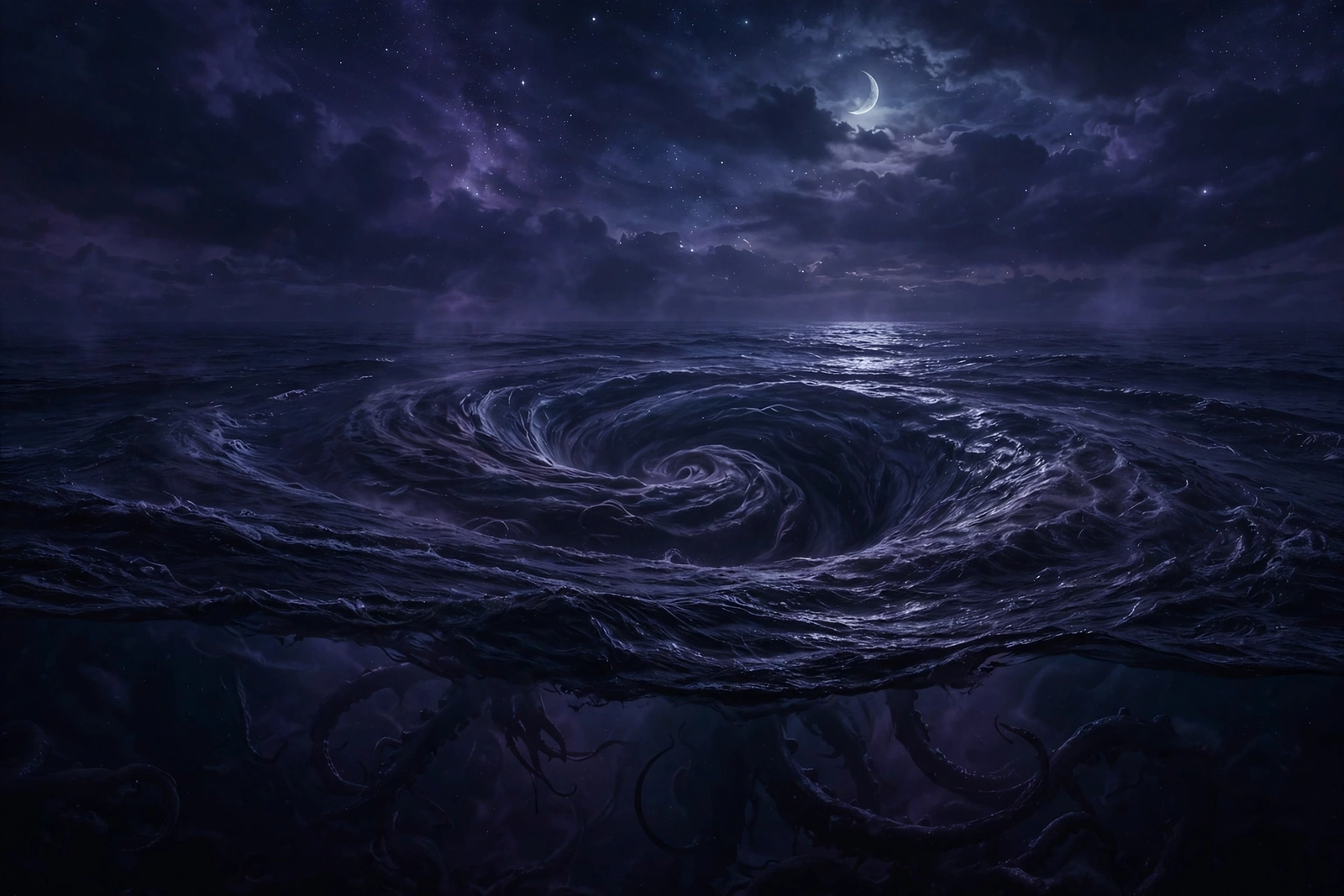
Pop culture keeps it surfacing — from Tennyson and Verne to Pirates of the Caribbean — giving a face to the oldest sailor’s fear: that the sea is deeper and stranger than charts admit. More ocean mysteries: our Bermuda Triangle disappearances piece.
People Also Ask About the Kraken Legend
Did the kraken really exist?
Not as the legend describes — no island-sized, ship-sinking cephalopod has ever been found. But the giant squid, a real animal up to 43 feet long, wasn’t photographed alive until 2004. The legend very likely grew from sailors’ encounters with this genuine deep-sea giant.
What does kraken mean in Norwegian?
“Kraken” is the definite form of “krake,” an old Norwegian word for an unhealthy or twisted animal — fitting for a creature sailors saw as wrong and alarming.
How big was the kraken supposed to be?
Accounts vary wildly, a telltale sign of folklore. Later retellings claimed island size or hundreds of feet. The real giant squid maxes out around 43 feet — impressive, but no island.
Is the colossal squid the same as the kraken?
No. The colossal squid lives in Antarctic waters, is heavier and stockier than the giant squid, and has swiveling hooks on its tentacles. Either species could have inspired kraken-like tales among southern sailors.
Kraken Legend FAQ
Q: Is the kraken real or just a myth?
A: The kraken as a ship-sinking monster is a legend, not a confirmed animal. But it likely grew from real sightings of the giant squid, a genuine deep-sea creature up to 43 feet long that scientists first photographed alive in 2004.
Q: Where did the kraken legend come from?
A: The legend comes from Scandinavian sailors in the North Atlantic. It was first mentioned in a Norwegian glossary in 1646, then described in detail by Bishop Pontoppidan in 1753, who wrote about a colossal octopus-like creature off Norway.
Q: How big can a real giant squid get?
A: Giant squid (Architeuthis dux) can reach about 43 feet (13 meters) long, including their two long feeding tentacles. They have the largest eyes in the animal kingdom, up to 27 cm across, built for seeing in the deep ocean’s darkness.
Q: Could a kraken actually sink a ship?
A: No. Even the largest real giant squid weighs around a ton and lives in deep water far below ships. It has never been known to attack a vessel. The ship-sinking tales are folklore, not marine biology.
External source: Kraken — Wikipedia (history of the legend and its link to the giant squid).
More Cryptids & Sea Legends stories:
- Loch Ness Monster: Sightings, Hoaxes & What Science Found
- Jersey Devil Legend: New Jersey’s Cryptid Since 1735
- Mokele-Mbembe: The Congo’s Dinosaur Legend
This article presents traditional beliefs and folklore for informational purposes only, not as proven fact. If you experience persistent distress, please consult a qualified professional.