Last updated: 11 November 2026
Searches for “how to properly use a ouija board” broke out in the United States this week, and the people typing it want the same thing: the rules, before they touch the board. The short answer is that proper use means a flat surface, two to four people, fingertips barely touching the planchette, one person asking the questions, and a deliberate close by moving the planchette to Goodbye. Everything else in this guide is the detail that keeps a session calm instead of chaotic.
Quick answer: To use a ouija board properly, set it on a flat table, sit with two to four people, rest your fingertips lightly on the planchette, let one person ask simple yes-or-no questions first, and always end by guiding the planchette to Goodbye. Never use it alone, never in a graveyard, and never believe everything it spells.
What Is a Ouija Board?
A ouija board, also called a talking board, is a flat board printed with the alphabet in two arched rows, the numbers 0 to 9, the words YES and NO in the top corners, and GOODBYE at the base. Most commercial boards add a sun symbol in one corner and a crescent moon in the other, and the letters are usually printed in an old-style gothic typeface. The pointer is the planchette, a small heart-shaped or triangular piece, often with a window, that slides across the board. The first patented version was different: a wooden board about fifteen by twenty-two inches, with a pointer that was a small four-legged table with felt feet. Players rest their fingertips on the planchette and ask questions out loud. The planchette then moves, spelling out letters or pointing to YES, NO, or a number.
Believers say a spirit moves the planchette. Psychologists say the people touching it move it without knowing they are doing so, through the ideomotor effect, which we cover below. Either way, the board itself is simple: a printed surface and a sliding pointer. What makes a session go well or badly is not the board. It is how the people around it behave.
Ouija Board Essentials at a Glance
| Detail | Fact |
|---|---|
| First sold | 1890, by the Kennard Novelty Company of Baltimore |
| Patented | 10 February 1891, US Patent 446,054, to Elijah J. Bond |
| Board size in the patent | About fifteen by twenty-two inches |
| Original pointer | A small four-legged table with felt feet, not the flat piece sold today |
| Owner today | Hasbro, which sells it as a game for ages 8 and up |

Key Stats: Ouija Board by the Numbers
- 10 February 1891 — US Patent 446,054 granted to Elijah J. Bond for the “Ouija or Egyptian luck-board”, filed 28 May 1890 in Baltimore.
- 1890 — the first commercial boards went on sale through the Kennard Novelty Company of Baltimore.
- 1852 — British physiologist William Benjamin Carpenter first described the ideomotor effect, the unconscious muscle movement behind the planchette.
- 65% vs 50% — in a 2012 University of British Columbia study, guessed answers came out right 65% of the time through the board, against 50% (chance) when spoken aloud. 27 students, 96 questions.
- 1966 — Parker Brothers bought the Ouija rights; Hasbro owns the trademark today.
- Breakout — “how to properly use a ouija board” is a Breakout search in the United States in the week to 11 November 2026 (Google Trends).
How to Use a Ouija Board Properly, Step by Step
The steps below are the ones serious practitioners have passed down for more than a century. They are the same in nearly every guide that ranks for this question, because they work whether you believe in spirits or not: they keep the planchette steady, the group calm, and the session short.
- Set up the board on a flat, stable surface. A table beats the floor or your knees. A wobbly surface makes it hard to tell real planchette movement from someone shifting the board by accident.
- Gather two to four people. Two is the minimum most guides insist on. More than four and fingers crowd the planchette, which makes small movements harder to feel and easier to push by mistake.
- Pick one person to lead. The leader asks the questions out loud, sets the pace, and makes the call to close the board if the session turns nasty. Everyone else stays quiet while a question is being asked.
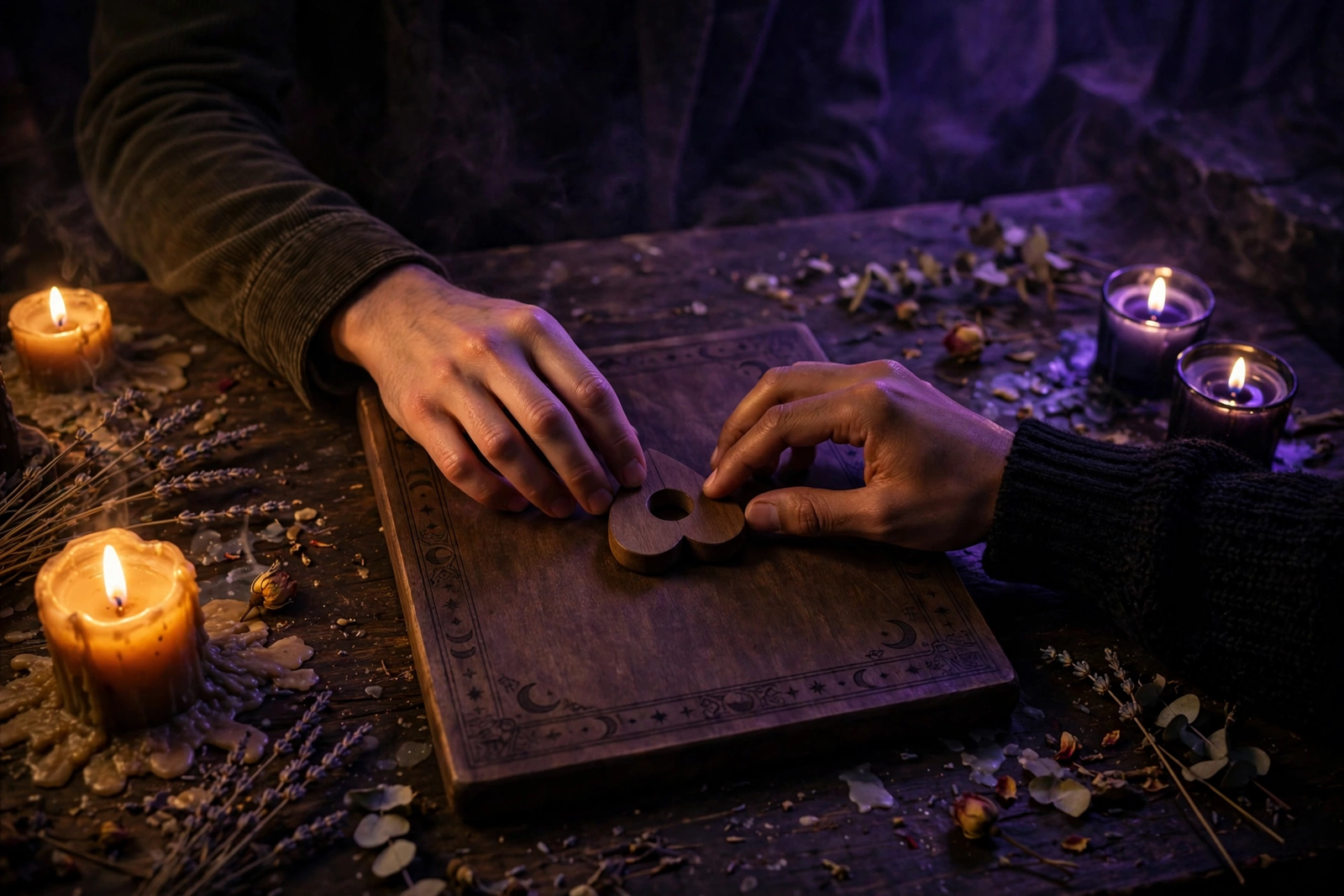
- Rest your fingertips lightly on the planchette. Use the pads of one or two fingers per hand, with almost no downward pressure. A tight grip kills the small, involuntary motion a session depends on, whatever you believe is behind it.
- Start with a simple yes-or-no question. “Is anyone here?” warms the group up and lets everyone get used to the feel of the planchette. Movement is often slow or absent for the first minute or two. Do not rush it.
- Ask one question at a time, out loud. Wait for the planchette to settle before the next question. Have one person with hands off the board write down each letter as it comes through, so nobody has to read and remember at the same time.
- Close the session on purpose. Guide the planchette to GOODBYE, let it settle there, then lift all hands at the same moment. An unclosed session is the one mistake every traditional guide treats as serious.
What Are the Rules Practitioners Warn About?
The board came with no official rule book. The rules below are the conventions practitioners have repeated for over a century, and they are the part of this topic that searchers most often get wrong by treating the board as a party game.
- Never use the board alone. A group steadies the planchette and gives everyone a shared check on what happened. Alone, the session is yours by default, and nobody can call it off for you.
- Never use it in a graveyard or a consecrated space. This is folk custom, not doctrine, but it is widely observed. Practitioners compare it to starting a conversation with a million strangers at once.
- Do not mock, challenge, or taunt whatever comes through. If you believe you are talking to something, provoking it is a bad idea. If you do not believe, it still wrecks the mood and the focus of the group.
- Do not ask for physical signs. Experienced users warn against asking the board to prove itself by moving something in the room or touching someone. It raises the fear level and never settles the question.
- Do not ask about death or the future as if the answers were facts. The board has no record of predicting anything reliably, and a frightening answer about a loved one can sit in a person’s head for weeks.
- Do not believe everything the board tells you. Treat every answer as a claim to check, not a verdict. The Spanish teenager whose story became the film Verónica is the cautionary tale practitioners cite: a session that went wrong, in a story retold as a warning. Read our account of the girl who played with the ouija board.

What to Do When a Session Turns Nasty
Sometimes the planchette starts spelling threats, insults, or strings of nonsense. Practitioners treat this as the moment to stop, not the moment to argue. Say Goodbye out loud, push the planchette to that word, and lift all hands together. Do not argue with the board, do not ask it to explain itself, and do not start a second session to find out what it meant.
If anyone in the group is frightened, the session is over, whatever the board says. Fear spreads fast in a dark room, and a scared group makes shaky hands, which makes wilder movement, which makes more fear. Break the loop by turning the lights on and talking normally for a few minutes before anyone touches the board again. If the fear lingers after the session, the practical step is the same one doctors advise for any frightening experience: talk to someone you trust, and if distress keeps coming back, speak to a qualified professional.
Something Had Followed Her Home
Folklore collectors at Indiana State University recorded dozens of stories like this one, published by JSTOR Daily in 2022 and updated in December 2025: after one unusually intense session with a ouija board, a woman became convinced something had followed her home, and the fear stayed with her long after the board was put away. Her friends had treated the session as a game. The story is retold here as a warning, not as proof: a session that starts light can end heavy, and the person left carrying it is often the one who took it least seriously at the start.
What to Do After You Close the Board
Most guides stop at Goodbye. Practitioners do not. The aftercare is part of proper use, and it is the section nearly every ranking page skips.
- Snuff the candle, do not blow it out. The old custom says blowing scatters what the session stirred. The practical point is simpler: a snuffed candle cannot tip over onto a wooden board.
- Wipe the board and planchette with a dry cloth. Fingerprints and dust make the planchette drag, which makes the next session harder to read.
- Store the board face down or wrapped, out of direct sunlight. Sunlight fades the print and warps the board. Some practitioners sprinkle a line of salt across the board before putting it away.
- Clear the room. Open a window, let fresh air in, and burn sage or incense if that is part of your practice. The point is a clear break between the session and the rest of the evening.
- Write down what happened. The note-taker’s sheet is the only record of what the board actually spelled. Memory in a dark room is unreliable, and the sheet stops the story from growing in the retelling.

What Does Science Say Moves the Planchette?
Science has a name for the movement: the ideomotor effect. It is the same small, unconscious muscle action behind a dowsing rod that seems to pull itself and a pendulum that seems to swing on its own. Your hands make tiny movements you do not notice and cannot feel yourself making, and the planchette, which is built to slide with almost no friction, follows them.
The clearest test came from the University of British Columbia in 2012. Researchers asked 27 students general-knowledge yes-or-no questions, first out loud and then through the board, with the students blindfolded and told a partner was moving the planchette with them. When students thought they were guessing, spoken answers landed at 50%, pure chance. Answers through the board came out right 65% of the time. The researchers read that as hidden memory surfacing through unconscious movement, not as contact with the dead. The full paper is published in Consciousness and Cognition (2012). Our own guide to whether ouija boards really work goes deeper into the 1891 patent and the science.

What Practitioners Believe vs What the Evidence Shows
The same session gets two very different readings. The table below puts them side by side, so you can see where the folklore and the research agree and where they part.
| What the folklore says | What the evidence shows |
|---|---|
| A spirit moves the planchette | The hands of the players move it through the ideomotor effect, first described by Carpenter in 1852 |
| The board can answer things nobody in the room knows | In the 2012 UBC study it surfaced answers people already knew without realising: 65% right through the board, 50% when spoken aloud |
| Leaving a session open is dangerous | No proof of harm exists, yet every traditional rule book treats closing the board as essential |
| The board itself is dangerous | There is no physical danger; the risk is fear and anxiety, mainly for people who are grieving or already struggling |
A Short History: From the 1891 Patent to Hasbro
The board’s story starts in Baltimore, not in a séance. In 1890 the Kennard Novelty Company began selling the talking board, and on 10 February 1891 lawyer Elijah J. Bond was granted US Patent 446,054 for the “Ouija or Egyptian luck-board”. The patent office had refused the application until Bond’s sister-in-law, the medium Helen Peters, demonstrated the board for the examiners. The name itself, the story goes, came from the board when the makers asked it what it should be called.
The board peaked in 1920, when grieving families after the First World War turned to it in large numbers, and it has stayed in print ever since. Parker Brothers bought the rights in 1966, and Hasbro owns the trademark today, selling the board as a game alongside film tie-ins. The Library of Congress guide to ouija boards in historic newspapers shows how widely the board was advertised in the 1890s. Smithsonian Magazine’s history of the board tells the full story, including the search for Bond’s lost grave.
Is Using a Ouija Board Safe?
Physically, yes: it is a printed board and a plastic pointer, and it cannot hurt you by itself. The risk people report is fear and anxiety, above all after a session that spells something threatening. That is why the safety advice around the board is really advice about people, not about the object. Our guide to whether the ouija board is dangerous sets out the five facts that matter most.
Three groups should stay away entirely, by the practitioners’ own rules: people who are grieving and hoping for a message from the dead, people living with anxiety or depression, and anyone under the influence of alcohol or drugs, since all three make a frightening session more likely and harder to shake off. Hasbro sells the board as a family game for ages 8 and up, but the guidance in this article is aimed at adults: children should never use one without an adult present, and anyone who finds the theme frightening should stay away. Everyone else should treat the board as what the patent called it, a toy or game, and keep the session short, the group small, and the close deliberate. If you are unsure, the safest rule is the simplest one: do not play.
People Also Ask About Using a Ouija Board
Can you use a ouija board alone?
You can, but nearly every practitioner warns against it. Two to four people keeps the planchette steady and gives the group a shared sense of what happened. Alone, every movement is yours by default, and there is no one to call the session off if it turns frightening. If you use one at all, use it with at least one other person.
Do ouija boards really work?
The planchette does move, but science traces that movement to the ideomotor effect: tiny, unconscious muscle movements from the people touching it. A 2012 University of British Columbia study found guessed answers came out right 65% of the time through the board, against 50% when spoken aloud, which points to hidden memory, not to a spirit. Believers read the same movement as a ghost answering.
What happens if you do not say goodbye on a ouija board?
In the folklore, leaving a session open is the one mistake practitioners take seriously: they say the channel stays open and the contact is left unfinished. There is no proof of harm, but the belief is so widely shared that every set of traditional rules ends the same way, by moving the planchette to Goodbye and lifting all hands together.
Is it dangerous to use a ouija board?
Physically, no: it is a printed board and a plastic pointer. The risk people report is fear and anxiety, especially after a session that spells something threatening. People who are anxious, grieving, or struggling with their mental health are the ones practitioners say should stay away. If a session leaves you shaken, stop, and talk to someone you trust.
Can you summon spirits with a ouija board?
That is not how practitioners describe it. “Summoning” is a word from films; the people who use talking boards say they invite contact and wait for a reply, and they warn that you cannot choose what answers. The safety rules in this article apply either way: use the board with others, keep the session short, and close it properly. If the idea of contact frightens you, do not try to test it.
More Ouija Stories
- Do Ouija Boards Really Work? 1891 Patent & Science
- Is the Ouija Board Dangerous? 5 Facts: The Complete Guide
- The Girl Who Played With the Ouija Board: Verónica (1991)
Questions or corrections about this article? Reach us through the contact page.
This article presents traditional beliefs and folklore for informational purposes only, not as proven fact. If you experience persistent distress, please consult a qualified professional.
1 thought on “How to Properly Use a Ouija Board: 7 Rules for 2026”