Last updated: 23 October 2026
Months after a breakup, plenty of people still feel tied to someone they’re trying to forget — random waves of sadness, replaying old fights, falling into the same patterns with someone new. The cord cutting ritual is a spiritual practice built exactly for that feeling. In the two-candle method, you tie two candles together with string — one for you, one for them — light both, and let the flame burn through the cord as you visualize the tie dissolving. It’s symbolic, it’s been all over TikTok, and as a belief-based ritual it asks for intention more than equipment. Here’s the full method, the safety rules, and what to do after.
- The keyword “cord cutting ritual” draws roughly 8,100 US searches a month (WordStream estimate).
- The two-candle method needs just 2 candles, 1 string, 2 holders, and a fire-safe tray.
- Black chime candles are the traditional choice (protection, banishing); white candles work as a cleansing alternative.
- TikTok’s #cordcuttingritual trend brought the practice to mainstream audiences in the last few years.
What is a cord cutting ritual? A symbolic spiritual practice in which you visualize and enact the severing of “energetic cords” — invisible emotional ties — between you and a person, place, habit, or situation you need to release.
What is a cord cutting ritual, exactly?
The idea comes from energy-work traditions: every strong relationship leaves an “energetic cord” between people, and some cords keep draining you long after the relationship ends. Cord cutting is the ritual of slicing that cord — not erasing memories, but draining the emotional charge so the past stops steering the present.
Believers use it after breakups, toxic friendships, leaving draining jobs, or breaking habits. It’s worth being clear about what it is and isn’t: it’s a spiritual and psychological ritual, not a medical or scientific treatment. What it reliably delivers is a structured moment of closure — naming what you’re releasing, watching something physical change, and walking away with a felt sense of an ending. For many people, that symbolism does real emotional work. For deep wounds, though, pair it with therapy, not instead of it. If toxic relationship patterns keep repeating, our guide to twin flame signs explores why intense connections hook us so hard.
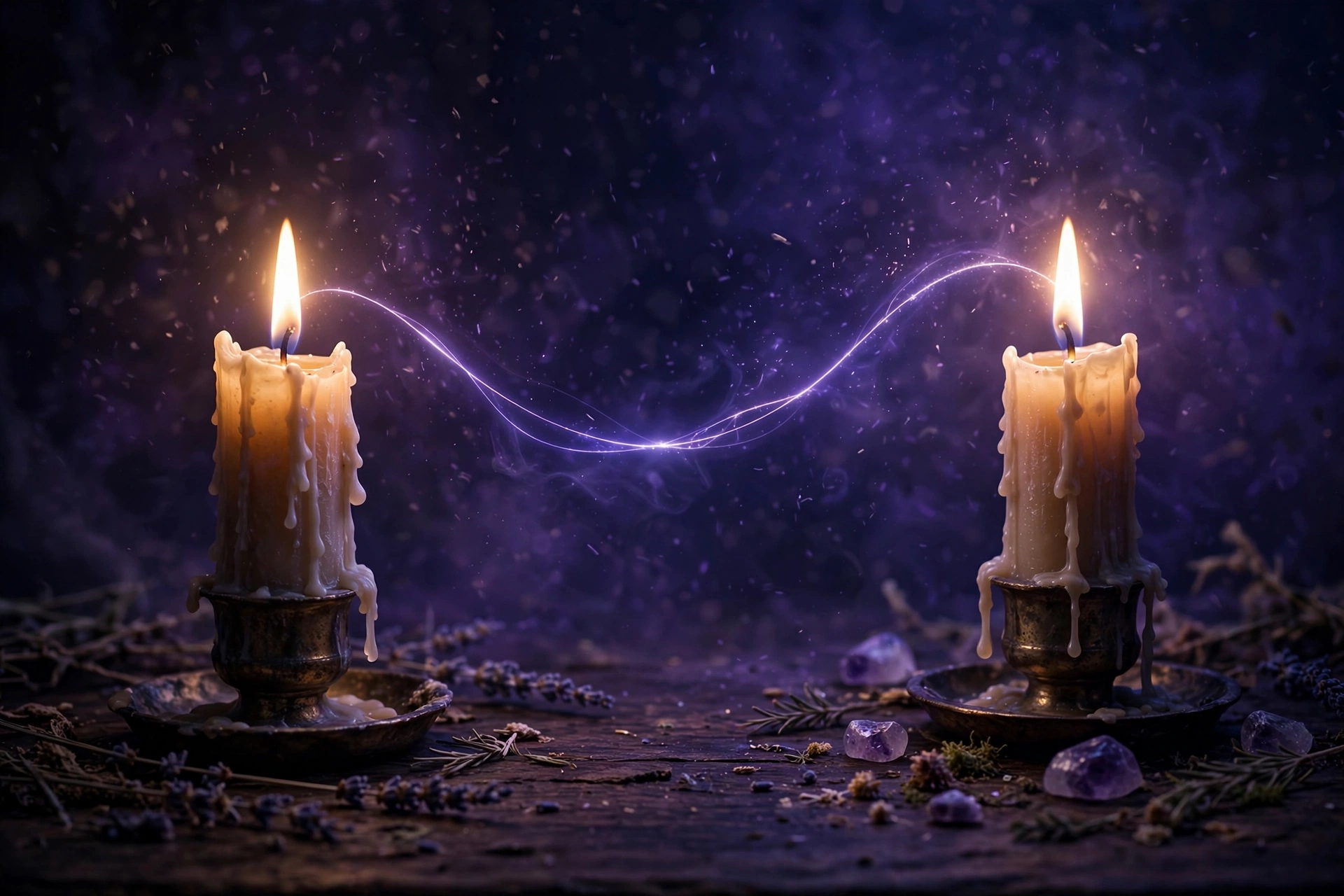
Signs of unhealthy cording — do you need a cord cutting ritual?
Not every rough week needs a ritual. In energy-work language, “unhealthy cording” means a tie that keeps draining you long after its time. Practitioners point to these recurring signs that an old tie is still running your life — and your relationships:
- You feel emotionally tied to an ex months or years after it ended — checking their socials, replaying conversations.
- Random waves of sadness or longing hit without an obvious trigger.
- You keep repeating the same toxic relationship pattern with different people.
- You struggle to open up to new love or new opportunities — something feels blocked.
- A place, job, or habit still shows up in your dreams long after you left it.
If two or three of these sound familiar, a cord cutting ritual can be a useful line in the sand. If what’s surfacing is serious trauma, grief that won’t lift, or anything affecting your safety, skip the candles and talk to a professional first — a ritual is no substitute for that.

What you need for the two-candle method
This is a short shopping list. Nothing exotic:
- Two candles — black chime candles are traditional (protection, banishing negativity); white candles work fine and symbolize purity and new beginnings.
- Two candle holders that fit the candles and sit steadily.
- A piece of string or natural twine — this is the “cord” between you and the other person.
- A fire-safe tray, plate, or dish to set everything on — ceramic, metal, or stone.
- A lighter or matches, and a small bowl of water nearby (safety first).
- Optional: a photo of the person or their name written on paper, sage or palo santo to cleanse the space, a quiet room where you won’t be interrupted.
Pick a calm, distraction-free spot and put the candles on the tray away from anything flammable — no loose papers, curtains, or fabrics. Open a window or burn sage first if you like a cleansed space; it’s optional, but it sets the mood.
Candle colors and their meanings
| Candle color | Traditional meaning in cord cutting |
|---|---|
| Black | Protection; banishing negativity — the classic choice |
| White | Purity, cleansing, new beginnings — the easy-to-find alternative |
| Pink | Self-love and emotional healing after a breakup |
How to perform the two-candle cord cutting ritual: step by step
- Set your candles apart. Place the two candles about 10 inches (25 cm) apart in their holders on the tray. One represents you, the other represents the person or situation. If you like, carve your name into one candle and theirs into the other.
- Tie the cord. Loop the string around each candle, about halfway down — not too close to the top or bottom. Pull the candles slightly apart so the string is taut between them.
- Set your intention. This is the heart of the ritual. Say clearly what you’re releasing: “I release all unhealthy ties with [name]. I keep the lessons; I release the pain.” Mean it — the intention matters more than the props.
- Light both candles. Light yours first, then theirs. Watch the flames for a moment and visualize the cord between you as a thread of light that is thinning, fraying, and dissolving.
- Let the string burn through. As the candles burn down, the flame will reach the string and burn it. Watch it happen — don’t rush it. Many practitioners say affirmations here: “I am free. I release you with love.”
- Read the flames (optional). Traditional candle-reading: a tall, steady flame suggests the work is flowing; flickering or crackling can mean resistance or timing that’s off. Take it as symbolism, not science.
- Close the ritual. When the cord breaks, say your closing words — “It is done.” Let the candles burn down safely, or snuff them out (never blow out ritual candles, practitioners say — it “blows away” the intention). Dispose of the remains respectfully: bury them, or throw them away outside your home.
Reading the flames: traditional interpretations
Practitioners have long read candle behavior as commentary on the work. Take it as symbolism, not science:
| What the flame does | Traditional reading |
|---|---|
| Tall, strong, steady flame | The work is flowing well |
| Low or weak flame | More inner work may be needed on the tie |
| Flickering, dancing, or crackling | Resistance — the attachment is fighting the release |
| Flame goes out on its own | The work is done |
That’s the whole method. The physical simplicity is the point: two candles, one string, one clear decision. For a broader look at energy-work practices, see kundalini awakening symptoms — and if timing and cycles are on your mind, Mercury retrograde effects covers the astrology angle.
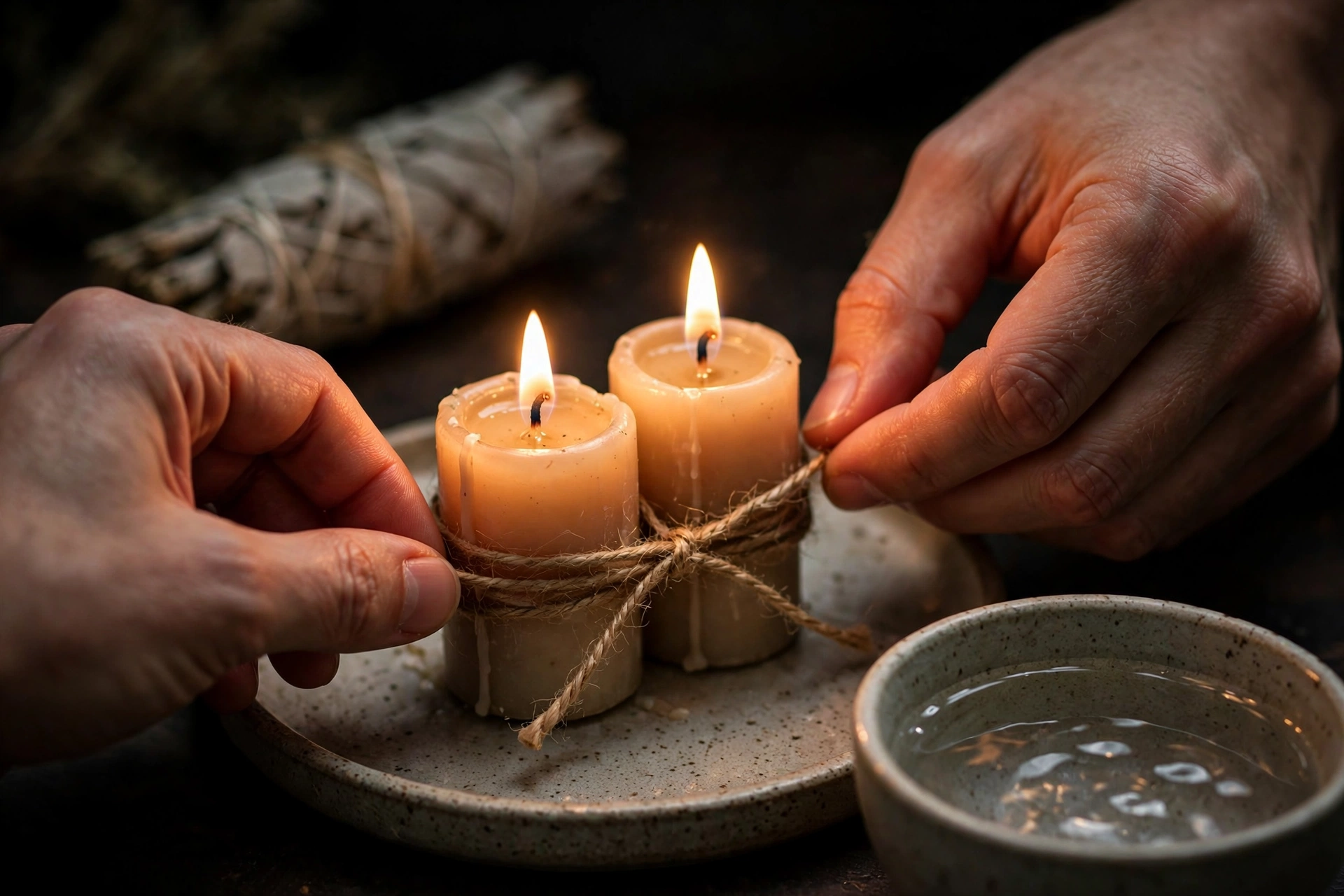
Fire safety rules — read this before you light anything
A cord cutting ritual involves open flame and burning string, so treat it like what it is: a small, controlled fire in your home.
- Never leave burning candles unattended. Not for a minute. If you must leave the room, snuff them out.
- Use a fire-safe surface — a ceramic or metal tray, never wood, plastic, or cloth underneath.
- Keep water or a fire extinguisher within arm’s reach.
- Keep candles away from curtains, bedding, papers, and pets.
- Tie the string mid-candle, not near the flame — a string too close to the wick can flare.
- If a flame gets out of control, smother it (a lid or damp cloth) rather than blowing on it.
- Don’t perform the ritual if you’re intoxicated, exhausted, or distracted — intention needs a clear head, and so does fire safety.
What to do after the ritual
Blow — sorry, snuff — the candles out, sit quietly for a few minutes, and notice how you feel. Many people report feeling lighter over the next few days; some feel emotional first, which is normal when you’ve just named something painful out loud. Journaling what came up helps lock in the closure.
Dispose of the candle stubs and the burnt string outside your home — practitioners say this keeps the released energy from lingering in your space. Then give it time. Cord cutting isn’t a spell with a delivery date; it’s a marker you’ve set for yourself. Many treat it as the start of a personal growth arc — clearer mental boundaries, lighter moods, and room for another, more positive chapter. Each individual’s timeline differs; the ritual just draws the line.
Repeat only if the charge comes back — one ritual per situation is the norm, though some people do a series over weeks for deep wounds. And one more time, because it matters: if you’re dealing with abuse, stalking, or serious trauma, the right move is a therapist, a support line, or — where safety is at stake — a restraining order. Rituals support healing; they don’t replace protection. A full overview of methods and meanings lives at WhimsySoul’s cord cutting guide.
Cord cutting methods compared
| Method | How it works | Best for |
|---|---|---|
| Two-candle method | Two candles tied with string; flame burns through the cord | People who want a visible, physical moment of release |
| Scissors visualization | Visualize golden scissors cutting the cord — no fire needed | Apartments, dorms, or anywhere open flame is impractical |
| Meditation cord cutting | Guided meditation dissolving the cord into light | Daily practice and gentle, repeated release |
| Write-and-burn | Write the person’s name or the pattern on paper, then burn it safely | Releasing a pattern or habit rather than a person |
A simple cord cutting version for beginners (no candles needed)
No candles? No problem. The two-candle method is the most visual, but the simplest beginner version needs nothing but a quiet room. Sit comfortably, close your eyes, and picture the person in front of you with a cord of light connecting you — many people see it running from heart to heart. Now picture a pair of golden scissors, and slowly, deliberately, snip the cord. Watch both cut ends dissolve into light, first on their side, then yours. Say your release words out loud: “I release this tie with love. I am free.”
This no-candles version works anywhere — a dorm room, an office, a parked car — and you can repeat it whenever the old pull resurfaces. The impact is quieter than the full candle ceremony, but practitioners say the mechanism is the same: a clear decision, visualized until it feels real. If you want the fuller sensory experience later, the two-candle ritual will be waiting.
Is cord cutting dangerous or black magic?
No — and this worry comes up a lot, so let’s settle it. Cord cutting isn’t black magic; there’s no invoking, no harm directed at anyone, no spirit bargaining. It’s a release ritual: you sever your end of an unhealthy attachment. The other person isn’t affected unless they choose to be — you’re simply withdrawing the energy you’ve been spending on them.
The real dangers are mundane, not magical: open flame (see the fire safety rules above) and the emotional wave that can follow a powerful release. Anyone telling you cord cutting will curse your ex or guarantee they’ll come back is selling something the tradition doesn’t claim. Used honestly — for closure, boundaries, and peace — it’s one of the gentlest practices in modern spirituality.
People also ask
What happens after a cord cutting ritual?
Believers commonly report feeling lighter and emotionally clearer in the days afterward, though everyone responds differently. Practitioners recommend resting, journaling about what you released, and disposing of the candle remains outside your home. If heavy grief surfaces, that’s normal — and a therapist is the right support for deeper wounds.
Can you do a cord cutting ritual for someone you’re still with?
Yes, according to most practitioners. Cord cutting releases unhealthy patterns — control, resentment, fear — not necessarily the relationship itself. You can cut cords to the toxic dynamics while staying with the person, ideally alongside honest communication or couples counseling.
How often should you do a cord cutting ritual?
There’s no fixed schedule. The common guidance is one ritual per situation — after a breakup, a job exit, a friendship ending — repeated only if the emotional charge returns. A rigid schedule misses the point; it’s a response to a felt need, not a maintenance routine.
Does cord cutting really work?
There’s no scientific evidence that cord cutting changes real-world outcomes — it’s a spiritual and psychological ritual, not a proven treatment. What it reliably provides is a structured, symbolic way to mark an ending, which many people find genuinely calming. Use it as a complement to therapy, never a replacement.
What candles are best for a cord cutting ritual?
Black chime candles are the traditional pick — they stand for protection and banishing negativity. White candles are the most common substitute and symbolize purity and new beginnings. Small chime or birthday candles work best because they burn down in a reasonable time; big pillar candles take hours.
Can cord cutting backfire?
Not in any supernatural sense — but it can stir up strong emotions, especially grief or anger you thought was buried. That’s normal, not a sign something went wrong. Give yourself a quiet evening after, journal what surfaced, and talk to a therapist if heavy feelings persist beyond a few days.
How long does a cord cutting ritual take?
Plan for 30 to 60 minutes of unhurried time. Small chime candles burn through the string in roughly 20–40 minutes depending on placement. Don’t rush it — the slow burn is part of the point. Never leave the candles burning while you do something else.
What do you do with the string after cord cutting?
Dispose of the burnt string with the candle remains — bury them or throw them away outside your home. Practitioners say this keeps the released energy from lingering in your space. Don’t keep the string as a souvenir; the ritual is about letting go, and the disposal is part of it.
Can you cut cords with a living parent or family member?
Yes — cord cutting isn’t only for exes. Many people use it for draining family dynamics: a controlling parent, a competitive sibling, an ex-friend. You’re not cutting the person out of your life; you’re cutting the unhealthy pattern between you. The relationship can actually improve once the old charge is gone.
Is cord cutting against religion?
It depends on your tradition. Cord cutting comes from energy-work spirituality, not from any major religion’s doctrine, so strict adherents of some faiths may see it as incompatible. Others blend it comfortably with prayer or meditation. If your faith matters to you, consider whether the practice fits your beliefs — or adapt it: a prayer of release can serve the same purpose.
What moon phase is best for cord cutting?
Practitioners who work with lunar timing favor the waning moon — the two weeks after the full moon — since it’s traditionally linked to release, banishing, and letting go. The new moon works too, as a reset point. Honestly, though, most teachers say timing is secondary: the right moment is when you genuinely feel ready.
More New Age stories
- Twin Flame Signs: 12 Ways You Know You’ve Met Yours
- Kundalini Awakening Symptoms: Signs, Triggers & Stages
- Mercury Retrograde Effects: 21% of the Year, Honest Guide
This article presents traditional beliefs and folklore for informational purposes only, not as proven fact. If you experience persistent distress, please consult a qualified professional.