
Last updated: 10 November 2026
A search phrase is spiking hard in the United States this week: “how to get sleep paralysis tutorial”, up 4,050% on Google Trends. Thousands of people are not trying to avoid sleep paralysis. They are asking one question: can you get sleep paralysis on purpose? The videos promise a doorway into lucid dreams, or even a trip out of the body. The short answer is that you can raise the odds of an episode by breaking your sleep on purpose, but sleep doctors say that is a bad trade.
Quick answer: Yes, you can get sleep paralysis on purpose by disrupting your sleep, which is exactly what the viral tutorials lean on. But sleep specialists advise against it: the same broken sleep that triggers an episode also wrecks your rest, feeds anxiety, and can turn a one-off fright into a nightly pattern.
What Is Sleep Paralysis?
Sleep paralysis is a brief gap between dreaming and waking. While you dream, your brain switches off most voluntary muscles so you do not act out the dream. This is called REM atonia, and it is normal and protective. Sleep paralysis happens when your mind wakes up a few seconds before that switch flips back off. You are aware, you can see the room, but you cannot move or speak. Most episodes end within seconds to about two minutes, and your breathing keeps going throughout, because the diaphragm is never part of the shutdown.
Every culture gave it a name. In Newfoundland folklore it is the Old Hag, a figure said to sit on the sleeper’s chest. In other traditions the intruder is a demon, a witch, or a shadow person. More than 100 cultures have their own name for it, which makes it a truly global experience. The names differ, but the reports match: a weight on the chest, a presence in the room, and fear far bigger than a few seconds of stillness. Science reads the same reports as a half-dreaming brain, still running dream imagery while the eyes are open.

Key Stats: Sleep Paralysis by the Numbers
- 7.6% of the general population has had sleep paralysis at least once, in a review of 35 studies covering 36,533 people (Sharpless & Barber, Sleep Medicine Reviews).
- 28.3% among students and 31.9% among psychiatric patients in the same review, so the rate climbs sharply in groups that sleep badly or under strain.
- About 5% of people have regular episodes, while most people who get it have it once or a handful of times in a lifetime.
- Seconds to about 2 minutes is the usual length of an episode. It ends on its own, or when the person is touched or spoken to.
- Teens and early 20s is when episodes most often start, which is also the age group driving the viral tutorial trend.
- +4,050% in US searches for “how to get sleep paralysis tutorial” in the week to 10 November 2026 (Google Trends), the biggest single spike of the day across the countries tracked.
Those numbers keep the topic in proportion. Sleep paralysis is common, it is brief, and it passes on its own. The spike in searches is new. The state itself is not.
Why Is “How to Get Sleep Paralysis” Trending Now?
The spike is not random. Search interest in “how to get sleep paralysis tutorial” jumped 4,050% in the US in the week to 10 November 2026, with related searches like “how to deal with sleep paralysis” (+140%) and “neuroscience of sleep paralysis” (+120%) climbing beside it. In Britain, “what does sleep paralysis look like”, “how to stop sleep paralysis in the moment” and “can you die from sleep paralysis” all broke out in the same week. The pattern is the same on both sides of the Atlantic: a short video describes an episode, the comments fill with people asking how to have one, and the search follows within hours.
The draw is the promise behind the tutorial. Lucid-dreaming forums have talked for years about sleep paralysis as a launch pad into a dream you control. Astral-projection videos go further, promising a trip out of the body. Neither claim has been shown in a lab. What has been shown is simpler: the tutorials work, when they work at all, by wrecking the night’s sleep.

Can You Get Sleep Paralysis on Purpose?
Can you get sleep paralysis on purpose? Yes, in the sense that you can push the odds up. Every method the tutorials share works on the same lever: break the normal sleep cycle so waking awareness and dream sleep overlap. Sleeping on your back, cutting the night short, waking in the middle of the night and going straight back to sleep, and sleeping at odd hours all raise the chance that REM atonia and waking awareness collide. None of these is a guarantee. Some people try for weeks and get nothing but tired, while others get an episode on the first broken night.
That gap between “possible” and “reliable” is the first warning. The only way to raise the odds is to damage the thing the tutorials claim to improve: your sleep. Sleep deprivation, fragmented sleep, and irregular sleep are the three strongest known triggers of sleep paralysis, and the three fastest ways to feel worse the next day. A clinical psychologist who writes on the topic puts it bluntly: he will not lay out a method for inducing it, because every reliable way to trigger it works by deliberately fracturing sleep. This article follows the same line. It explains the mechanism and the risks, and it does not give a recipe to follow in bed tonight.
| What the tutorials claim | What the science says |
|---|---|
| Anyone can learn it in one night | No method works every time; broken sleep only raises the odds, and some people try for weeks and get nothing but tired |
| It opens a lucid dream you control | It is waking awareness plus dream imagery leaking in, not a dream you steer |
| It lets you leave your body | No study has shown out-of-body travel; the floating feeling is a known hallucination of the half-dreaming brain |
| It is harmless fun | The cost is broken sleep, worse mood, and a fear-of-bedtime loop that can make episodes more frequent |
There is a second warning the tutorials skip. If you already sleep badly, or you live with anxiety, depression, or post-traumatic stress, the odds of an episode are higher to start with, and the episode itself is more likely to scare you.
Why Do People Ask “Can You Get Sleep Paralysis on Purpose?”
Curiosity is the honest answer for most people who search “can you get sleep paralysis on purpose”. Sleep paralysis sounds like a hidden feature of the mind, and a tutorial makes it sound like a skill you can learn in one night. The lucid-dreaming angle is the most common pitch: stay aware while your body falls asleep, and you roll into a dream you steer. Both promises lean on the same real detail, the strange sensations at the edge of sleep, the buzzing, the floating, the sense of leaving the bed, and then read a meaning into them that no study has backed.
A smaller group comes at it from the other side: they have already had an episode, it scared them, and they want to repeat it on their own terms. That motive is easy to understand, and it still points the wrong way. Repeating a frightening state to master it only works when the state is safe to repeat, and broken sleep is not.
What Does Sleep Paralysis Feel Like?
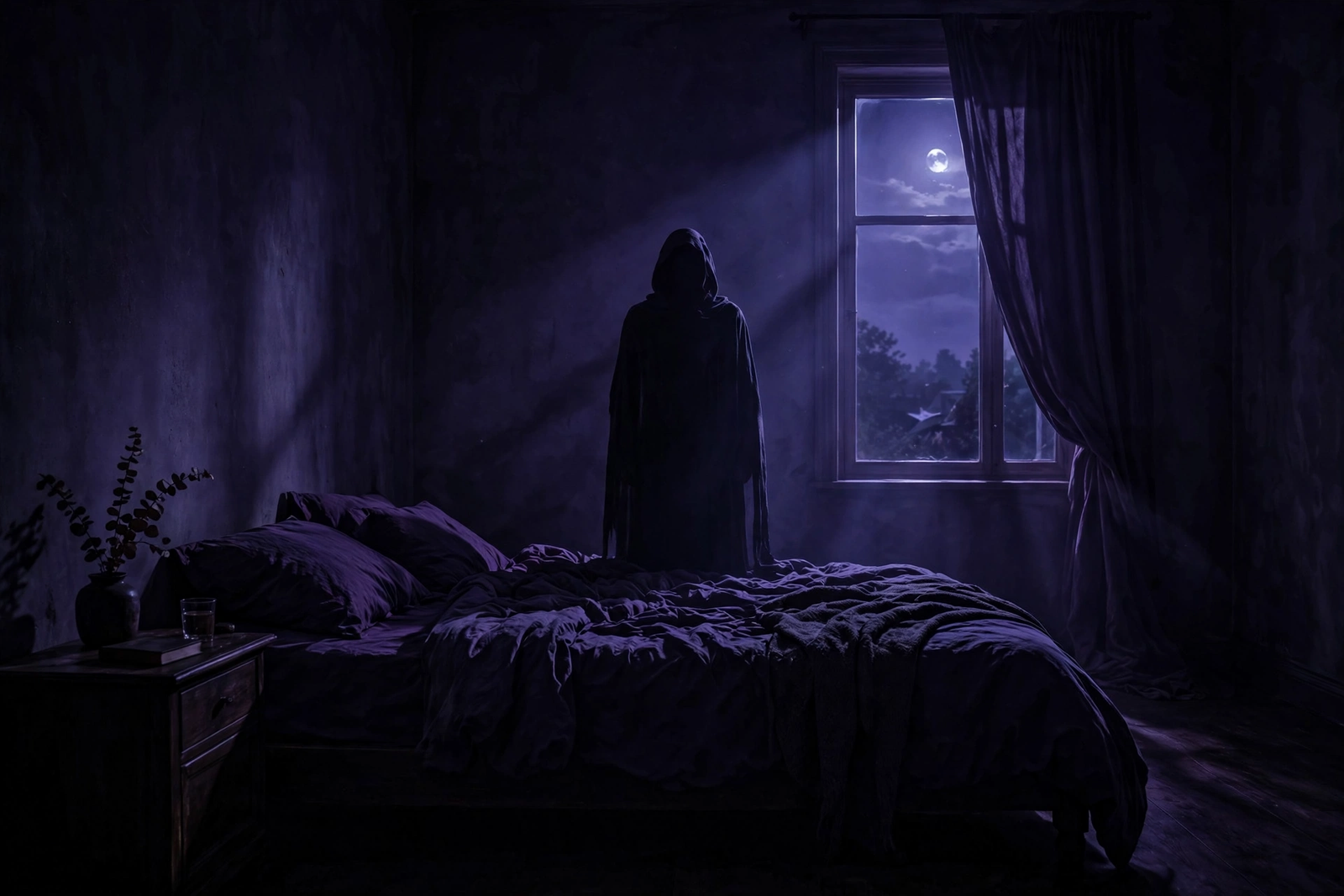
Ask ten people and you get the same three ingredients in different mixes. First, the body will not move. You try to sit up, or to call out, and nothing answers. Second, something feels present: a shadow at the foot of the bed, a figure by the door, or a weight pressing on the chest. Third, the fear is far bigger than the facts. You know, even mid-episode, that nothing is touching you, and you are still terrified. The whole thing usually passes in seconds to a couple of minutes, and movement returns all at once.
The figure has a long history. In Newfoundland the Old Hag is said to sit on the sleeper, and that story grew out of real episodes told and retold. In other traditions the visitor is a demon, and the figure people see follows its own pattern, which we cover in our guide to the sleep paralysis demon. The science behind both is the same: the dreaming brain is still switched on while the eyes are open, so dream images land on a real room. A 2023 study cited in a recent medical review found links between paranormal beliefs and different sleep factors, which helps explain why the same frightening night gets a ghost story in one house and a medical label in another.
Sleep Paralysis Symptoms and Causes
The symptoms cluster into three groups that researchers describe again and again: you cannot move or speak; you sense a presence, often with hallucinations of a figure, a weight on the chest, or a floating feeling; and you feel intense fear. Most individuals experience only one or two of these at a time, and the whole episode passes in seconds to a couple of minutes. The best-known count comes from Sharpless and Barber’s 2011 review, which pooled 35 studies and 36,533 people.
The causes are better understood than the cures. The strongest factors are sleep deprivation, an irregular sleep schedule, stress, and sleeping on your back. Medical research also links episodes with narcolepsy, obstructive sleep apnea, and other sleep disorders, and with substances such as alcohol that break up sleep. A 2024 review in Cureus lists hypertension and obstructive sleep apnea among the medical disorders associated with sleep paralysis, and notes that episodes often run in families. Experiencing it once does not mean you have a disorder: most cases are isolated sleep paralysis, a one-off glitch in an otherwise healthy sleeper.
Diagnosis and Tests
Doctors usually diagnose sleep paralysis from your history alone: what happened, when it happened, and how often. No test is needed for a rare, one-off episode. If episodes keep coming, or come with heavy daytime sleepiness, a doctor may order a sleep study, called polysomnography, or a daytime nap test, to check for narcolepsy or sleep apnea. These tests measure brain waves, breathing, and muscle tone across the night, and they separate ordinary sleep paralysis from a disorder that needs treatment.
Management and Treatment
There is no treatment for a rare episode, because there is nothing to fix: the episode ends on its own. Management means fixing the sleep around it. That is the finding of a 2024 review in Cureus, which sums up the research on mechanisms and treatment. Doctors start with sleep hygiene, a steady schedule and enough sleep, and then treat any underlying disorder they find, such as narcolepsy or sleep apnea. In stubborn cases, a sleep clinic may use cognitive behavioural therapy for insomnia, and medication only where an underlying condition calls for it.
Sleep Paralysis vs Night Terrors vs Lucid Dreaming
The three states get mixed up in the comments under every tutorial, so here is the split that matters. Our guide to night terrors in adults covers the middle row in more depth.
| State | Awake or asleep? | Can you move? | What you see | Memory after |
|---|---|---|---|---|
| Sleep paralysis | Mind awake, body in dream shutdown | No | Vivid figures, pressure on the chest | Clear, often detailed |
| Night terrors | Asleep, in deep sleep | Yes, may sit up, shout, or thrash | Confused images, rarely a clear figure | Little or none |
| Lucid dreaming | Asleep and dreaming, aware it is a dream | Dream body moves; real body stays still | A full dream world, often pleasant | Varies |
The split matters because the tutorials sell sleep paralysis as a lucid dream. It is not one. In a lucid dream you steer the dream. In sleep paralysis you are awake in a real room, unable to move, while dream images leak in.
What Are the Risks of Trying to Trigger It?
The first risk is the obvious one: worse sleep. The tutorials that answer “can you get sleep paralysis on purpose” with a yes never mention the price. They need you to sleep less, sleep at the wrong hours, or wake yourself up through the night. Do that for a week and the cost shows up in daylight: low mood, short temper, poor focus, and a weaker immune system. The state people chase is a glitch in sleep, and the price of chasing it is the sleep itself.
The second risk is the pattern. Sleep paralysis feeds on broken sleep, and broken sleep feeds on the fear of another episode. People who get an episode often start dreading bedtime, sleep worse because of the dread, and then get another episode. That loop is the real danger of the tutorials, and it is why sleep doctors call the trade a poor bargain.
The third risk is a missed signal. Frequent episodes can point to narcolepsy, a sleep disorder that also brings heavy daytime sleepiness and sudden muscle weakness. If episodes come often, or you fall asleep without warning in the day, see a doctor, not another tutorial.
Can Sleep Paralysis Be Prevented?
If it happens, the first job is to wait it out. The episode ends on its own, usually within seconds to a couple of minutes. Focus on the smallest movement you can make, a finger or a toe, and keep breathing slowly. Remind yourself what it is: your body is still in dream mode, and the switch is already on its way back. Trying to fight your way out with a big movement tends to feed the panic; small movements and slow breaths break the loop faster.
To make episodes less likely, the advice is the boring kind that works: keep a steady sleep schedule, even on weekends; get enough sleep; avoid alcohol and heavy meals late at night; and deal with stress in the day rather than carrying it to bed. Sleeping on your side instead of your back also helps some people, since back-sleeping is a known trigger.
| What raises the odds | What lowers them |
|---|---|
| Sleeping on your back | Sleeping on your side |
| Short or broken nights | Steady, full nights of sleep |
| Irregular sleep hours | The same bedtime and wake time every day |
| Stress and anxiety carried to bed | A wind-down routine and daytime stress relief |
| Alcohol late at night | No alcohol near bedtime |
Will Sleep Paralysis Happen Again? Outlook and Prognosis
For most people, no. A single episode is the common pattern, and the outlook is good: it does not damage the brain, and it does not mean a disorder is coming. Recurring episodes point to the habits around sleep, not to the episode itself, so fixing the schedule usually fixes the pattern.
How to Take Care of Yourself After a Sleep Paralysis Episode
Take the morning slowly, note what was different about the night before, a late bedtime, a stressful day, a drink, and fix that one thing first. If the fear lingers, talk about it: the episode feels less strange once you know how common it is.
When Should You See a Healthcare Provider?
See a doctor if episodes happen often, if they leave you afraid to sleep, or if daytime sleepiness or sudden muscle weakness comes with them. A sleep clinic can rule out narcolepsy. If the experience leaves you shaken, the NHS guide to sleep paralysis is a solid, plain-English place to start.

People Also Ask About Sleep Paralysis on Purpose
Can you die from sleep paralysis?
No. Doctors describe sleep paralysis as frightening but not dangerous: you keep breathing throughout, because the muscles that matter for breathing are never switched off, and every episode ends on its own, usually within seconds to a couple of minutes. The risk in the viral tutorials is different: it is the broken sleep they ask you to keep breaking.
Is sleep paralysis dangerous?
On its own, no. It is classed as a parasomnia, a glitch in the sleep cycle, not a mental illness. The risk sits in what causes it: broken sleep, heavy stress, and, in some people, narcolepsy. If episodes are frequent or come with daytime sleepiness, get the cause checked rather than the episode itself.
Why do I see a demon during sleep paralysis?
Because your dreaming brain is still running while your eyes are open. The hallucination, a figure, a weight on the chest, or a sense of presence, is dream imagery landing on a real room. Cultures named the figure a demon, a witch, or the Old Hag. The name changes by country; the mechanism does not.
How do I stop sleep paralysis when it happens?
Wait it out and move small: wiggle a finger or a toe, breathe slowly, and remind yourself it will pass in seconds to a couple of minutes. For the longer term, steady sleep hours and enough sleep cut the odds far better than any trick. If episodes keep coming, talk to a doctor.
More Sleep Paralysis Stories
- Old Hag Syndrome: Sleep Paralysis Folklore Explained
- Sleep Paralysis Demon: Why You See a Figure
- Night Terrors in Adults: Causes and How to Cope
Questions or corrections about this article? Reach us through the contact page.
This article presents traditional beliefs and folklore for informational purposes only, not as proven fact. If you experience persistent distress, please consult a qualified professional.
1 thought on “Can You Get Sleep Paralysis on Purpose? 2026 Guide”