
In 1587, about 115 English colonists landed on Roanoke Island off the coast of present-day North Carolina. Three years later, their governor returned with supplies — and found every house dismantled, every person gone, and a single word carved into a fence post: “CROATOAN.” That is the Roanoke Colony disappearance, America’s oldest unsolved mystery. Here’s what the records actually say — and what historians think really happened.
Last updated: October 24, 2026
- Colonists: about 115 men, women, and children (sources cite 112–121)
- Founded: 22 July 1587 on Roanoke Island, North Carolina, under Sir Walter Raleigh’s charter
- Governor: John White, who returned to England for supplies in late 1587
- Return: 18 August 1590 — three years later, delayed by the Anglo-Spanish War
- The only clues: “CROATOAN” carved on a post, “CRO” carved on a tree
- Drought: tree-ring data shows one of the worst droughts in 800 years hit the region 1587–1589
What is the Roanoke Colony disappearance? It is the unexplained fate of England’s 1587 colony on Roanoke Island: when Governor John White returned in 1590, all ~115 settlers were gone, leaving only the carved word “CROATOAN” behind.
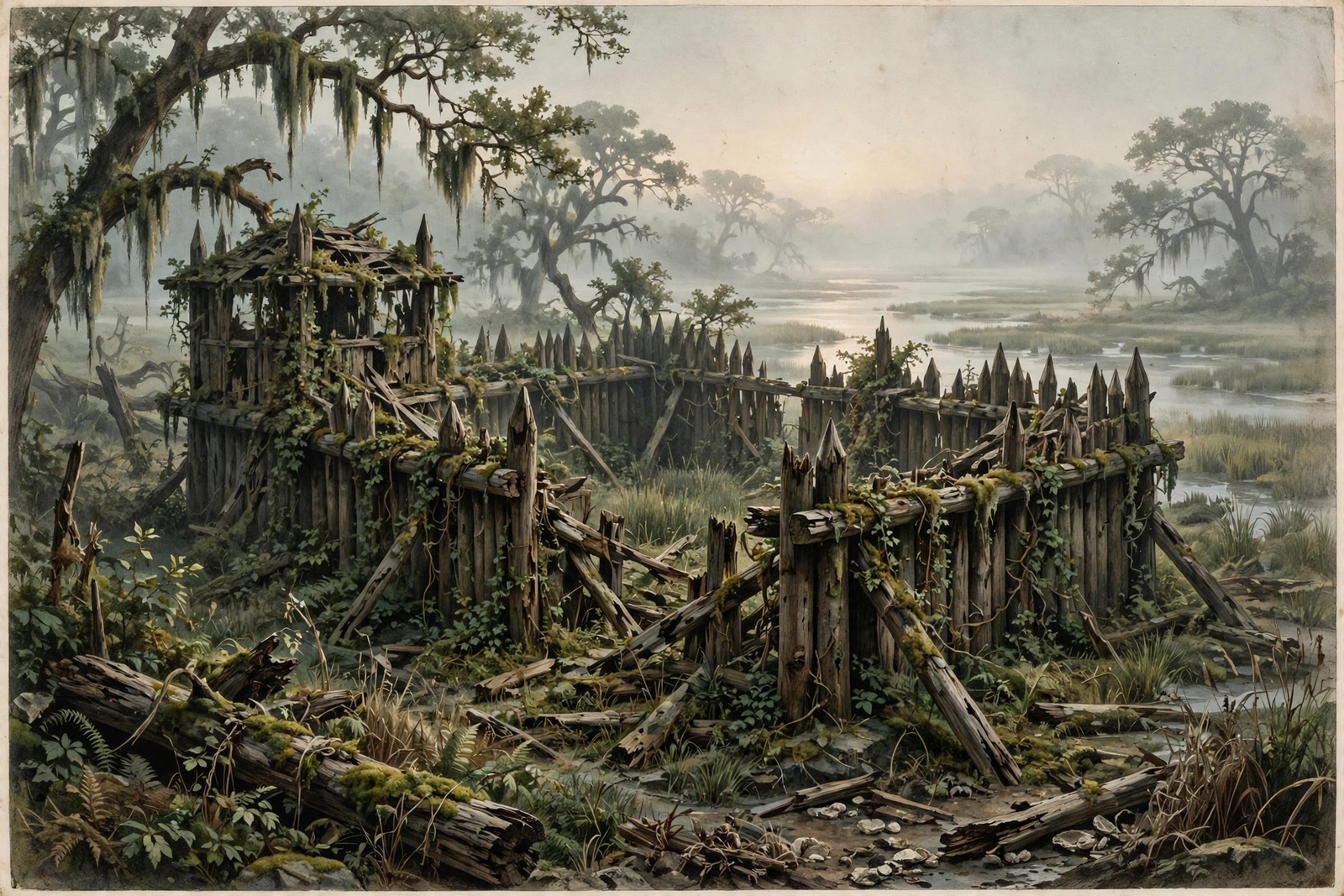
What happened to the Roanoke Colony between 1587 and 1590?
The Amadas-Barlowe expedition of 1584
The story starts before the colony. In 1584, Sir Walter Raleigh sent Philip Amadas and Arthur Barlowe to scout the Carolina coast. They returned with glowing reports of a “land of plenty” — and with two Native men, Manteo and Wanchese, who traveled to England. Those reports sold the colony idea.
Establishment of the colony in 1587
The colony was in trouble almost from the start. The settlers were supposed to land at Chesapeake Bay, but the ship’s crew deposited them on Roanoke Island on 22 July 1587 and sailed off.
Hostilities and food shortages
Relations with local tribes were already strained from an earlier 1585 expedition — one colonist, George Howe, was found dead on the beach just six days after landing.
Grenville’s detachment
The 1585 expedition had its own vanishings: when its leader Richard Grenville sailed home in 1586, he left 15 men with two years of supplies to hold the fort. They were never seen or heard from again — a grim preview of 1590.
Governor John White sailed back to England in late 1587 to fetch supplies, leaving behind his daughter Eleanor and his newborn granddaughter Virginia Dare, the first English child born in the Americas. Then came disaster at home: war with Spain, the Spanish Armada of 1588, and a total freeze on ships. White could not return until August 1590. Three years is a long time for a struggling outpost to wait.
Roanoke Colony timeline
| Date | Event |
|---|---|
| 1584 | The Amadas-Barlowe expedition scouts the Carolina coast for Raleigh |
| 1585 | Ralph Lane’s military colony settles Roanoke; relations with the Roanoke people sour |
| Jun 1586 | Lane’s colonists abandon Roanoke; Grenville leaves 15 men who are never seen again |
| 22 Jul 1587 | John White’s colony of ~115 settlers lands on Roanoke Island instead of Chesapeake Bay |
| 18 Aug 1587 | Virginia Dare is born — the first English child born in the Americas |
| Late 1587 | White sails for England to fetch supplies |
| 1588 | The Spanish Armada delays all relief ships |
| 18 Aug 1590 | White returns to find the settlement abandoned; “CROATOAN” carved on a post |
What did John White find when he returned in 1590?
The 1590 relief mission
On 18 August 1590, White rowed ashore to a completely abandoned settlement. But it was not a scene of violence — and that’s the detail that matters most. The houses had been dismantled, not burned. No bodies, no burned ruins, no scattered belongings. Someone had taken the time to pack.
The only clues were two carvings: the word “CROATOAN” on a palisade post and “CRO” on a tree. Crucially, White had agreed with the colonists before leaving: if they moved, they would carve their destination, and if they were in danger they would add a Maltese cross. There was no cross. Storms then prevented White from sailing to Croatoan Island (modern Hatteras Island), and he was forced back to England. He never saw his family again.

What does CROATOAN mean?
Croatoan was the English name for an island south of Roanoke — today’s Hatteras Island — and for the Croatan people who lived there. The colonists were telling White where they had gone. The Croatan were considered friendly to the English, and their leader Manteo had traveled to England years earlier as a go-between.
White’s own journal shows he took the carving at face value: he fully believed the colonists had moved to Croatoan. What he could not do was check — the weather drove his ships off, and England never sent him back.
What are the leading theories about the Roanoke Colony disappearance?
Historians weigh four main explanations. Here’s each one with the evidence for and against it:
| Theory | Evidence for | Evidence against |
|---|---|---|
| Moved to Croatoan and assimilated (leading theory) | The CROATOAN carving; no distress sign; dismantled houses; English artifacts found at Hatteras sites; the Lumbee people’s ancestral claims | No confirmed settlement or mass graves found; later searches of Hatteras turned up nothing conclusive |
| Starvation and drought | Tree rings confirm a brutal drought 1587–1589; supplies never came; strained tribal relations cut off food trade | Explains hardship, not where the people went |
| Killed in conflict | Relations were tense after the 1585 violence; later Jamestown rumors spoke of a massacre | No burned structures, no weapons, no remains — violence usually leaves traces |
| Spanish attack | Spain was active in the region and at war with England | Now largely discounted by scholars; no Spanish record of such a raid exists |
Wilder ideas — mass alien abduction, a curse — belong to entertainment, not history. Even the famous Dare Stones, carved rocks supposedly telling the colonists’ story, are regarded by most scholars as later hoaxes.

Does the evidence support the assimilation theory?
| Evidence for assimilation | What still doesn’t fit |
|---|---|
| The “CROATOAN” carving names the Croatan people and their island | No confirmed English settlement has been found on Hatteras Island |
| Houses were dismantled, not burned — an orderly move, not a massacre | Later searches of the island turned up no colonists |
| No Maltese cross distress sign was carved | The Lumbee ancestral claims are oral tradition, not documentation |
| Tudor-era artifacts found inside Native sites on Hatteras | The Dare Stones were discredited as later hoaxes |
Scientific research: climate and archaeology
A 1998 tree-ring study confirmed that one of the worst droughts in 800 years struck the Outer Banks from 1587 to 1589 — crops failed and trade with local tribes collapsed. More recent excavations on Hatteras Island have turned up Tudor-era ceramics and iron-working fragments inside Native sites, suggesting English and Indigenous people lived side by side.
Investigations into Roanoke
The honest answer: the leading theory is assimilation, but nobody can prove it. The U.S. National Park Service’s Fort Raleigh page lays out the major theories and notes that after more than 430 years, none has been definitively proven. Recent scholarship has moved away from the Spanish-attack story toward a combination theory: drought and isolation forced the colonists off Roanoke, and survivors merged with Indigenous communities — perhaps the Croatan, perhaps others.
Spanish reconnaissance of the coast
Spain was actively hunting for English footholds in the 1580s — Spanish ships probed the Carolina coast looking for rival settlements. That real Spanish presence is one reason the attack theory took hold, even though no Spanish record of a raid on Roanoke has ever surfaced.
1607–1609: John Smith’s searches
After Jamestown was founded in 1607, Captain John Smith sent men to look for the lost colonists. They found rumors of light-skinned people living to the south — tantalizing, but rumors are not evidence.
1610–1612: William Strachey’s report
Jamestown colonist William Strachey wrote in 1612 that the Roanoke settlers had tried to settle at Chesapeake Bay and were killed there. No graves or artifacts have ever confirmed his account, and most historians treat it as hearsay.
Archaeological research continues
The First Colony Foundation keeps digging on the Outer Banks, and each artifact — a Tudor potsherd here, an iron-working fragment there — adds a little more to the picture. The mystery endures because the evidence is real but incomplete.
For the Park Service’s own rundown, see the Fort Raleigh National Historic Site page.
Can you visit the Roanoke Colony site?
Yes — and you should. The colony site is preserved as the Fort Raleigh National Historic Site on Roanoke Island, North Carolina, about 3 miles north of the town of Manteo — added to the National Park System in 1941. The Lindsay Warren Visitor Center has exhibits on the Roanoke voyages and the Carolina Algonquians, and you can walk the grounds where the settlement stood.
Since 1937, the outdoor drama The Lost Colony has been performed at the Waterside Theatre on the site, telling the colonists’ story under the stars. It’s one of America’s longest-running outdoor plays — and a moving way to end a visit.
People also ask about the Roanoke Colony
Who was Virginia Dare?
Virginia Dare was Governor John White’s granddaughter, born on Roanoke Island on 18 August 1587 — the first English child born in the Americas. She was an infant when White left for England, and she was never found.
Why did John White leave the colony?
The colonists asked White to sail back to England personally to plead for urgent supplies. He left in late 1587 but was delayed by the Anglo-Spanish War and the 1588 Armada, returning only in August 1590.
Did the colonists leave any other clues?
Beyond “CROATOAN” and “CRO,” there were no letters, graves, or markings. The absence of the agreed-upon Maltese cross distress sign is itself a clue — it suggests the move was planned, not panicked.
What was the first Roanoke expedition?
An earlier all-male military colony under Ralph Lane settled Roanoke in 1585 but abandoned it in 1586 after food shortages and violent conflict with the Roanoke people. The 1587 group was the second attempt — and included families.
Frequently asked questions
What happened to the Roanoke Colony?
Unknown. The leading view is that the colonists relocated — likely to Croatoan/Hatteras Island — and assimilated with local tribes, but this remains unproven.
What does CROATOAN mean?
It refers to an island (now Hatteras Island) and the Croatan people living there — the colonists’ likely destination.
How many colonists disappeared at Roanoke?
About 115 men, women, and children sailed with the 1587 expedition.
Has the Roanoke mystery been solved?
No. Excavations continue, and the evidence leans toward assimilation — but no one can say for certain.
More Unsolved Mysteries stories
- Dyatlov Pass Incident Explained: 1959 Mystery
- Max Headroom Broadcast Signal Intrusion (2026): 1987 Mystery
This article presents traditional beliefs and folklore for informational purposes only, not as proven fact. If you experience persistent distress, please consult a qualified professional.