
No — the Philadelphia Experiment didn’t happen. But the Philadelphia Experiment story, explained properly, is still fascinating: a real warship, real Navy research, and one strange man’s 1955 letters that snowballed into America’s most durable military conspiracy theory.
Last updated: 21 October 2026
- USS Eldridge (DE-173) — a real Cannon-class destroyer escort, commissioned in August 1943. The ship existed; the experiment didn’t.
- October 28, 1943 — the claimed date. Official logs place the Eldridge in New York waters, nowhere near the Philadelphia Naval Shipyard.
- ~250 miles — the claimed teleportation distance from Philadelphia to Norfolk, Virginia, and back.
- 1955 — the year Carl Allen, writing as “Carlos Allende,” sent his letters to UFO author Maurice Jessup, birthing the legend.
- 2,000 amps — the electrical “wiping” cables the Navy dragged along hulls in real degaussing work against German magnetic mines.
- 1984 — the film The Philadelphia Experiment cemented the legend in pop culture.
What is the Philadelphia Experiment? An alleged 1943 U.S. Navy test, also called “Project Rainbow,” in which the destroyer escort USS Eldridge was supposedly rendered invisible — then teleported from Philadelphia to Norfolk and back — with horrific effects on its crew.
Did the Philadelphia Experiment really happen?
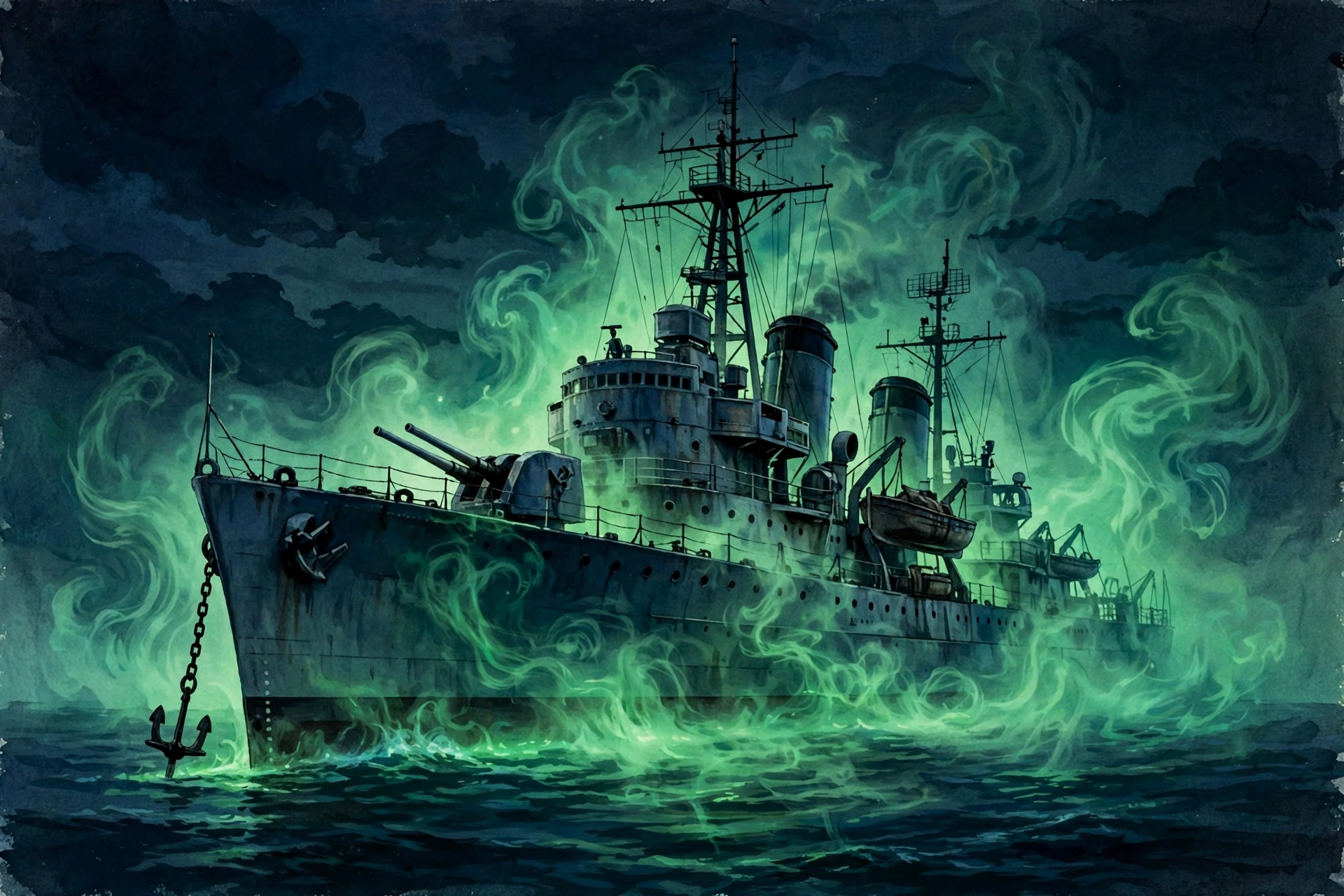
No. The U.S. Navy has repeatedly stated that no such experiment was ever conducted, and the details of the story contradict the USS Eldridge’s own records. On October 28, 1943 — the claimed date — the ship’s logs place it in New York waters, not in Philadelphia or Norfolk. The physics the story relies on didn’t exist in 1943, and no crew member or document has ever corroborated it. The legend is a story, not a secret that leaked.
The numbers close the case further. The Eldridge was commissioned on August 27, 1943 and stayed in New York waters into September, so there was no October window for a Philadelphia teleportation test. The Office of Naval Research stated in September 1996 that it had “never conducted investigations on radar invisibility, either in 1943 or at any other time” — and pointedly, the ONR wasn’t even established until 1946. At an April 1999 reunion, surviving Eldridge veterans told a Philadelphia newspaper their ship had never made port in Philadelphia at all. Believers patch the gap by substituting USS Hammann (DE-131), which reached the shipyard on October 20, 1943 — but the Hammann appears nowhere in Allen’s own eyewitness account, the one place the story began.
What was the Philadelphia Experiment supposed to be?
General synopsis of the legend
According to the legend, Navy researchers wrapped the Eldridge in massive electromagnetic coils to test Einstein’s unified field theory as a radar cloak. A greenish fog swallowed the ship — it vanished from Philadelphia and reappeared in Norfolk, Virginia, 250 miles away, even arriving minutes before it left. Then it teleported back. The alleged cost: sailors fused into the hull, bursting into flames, driven insane, or vanishing — plus a massive cover-up.
What was the USS Eldridge, and where was it on October 28, 1943?
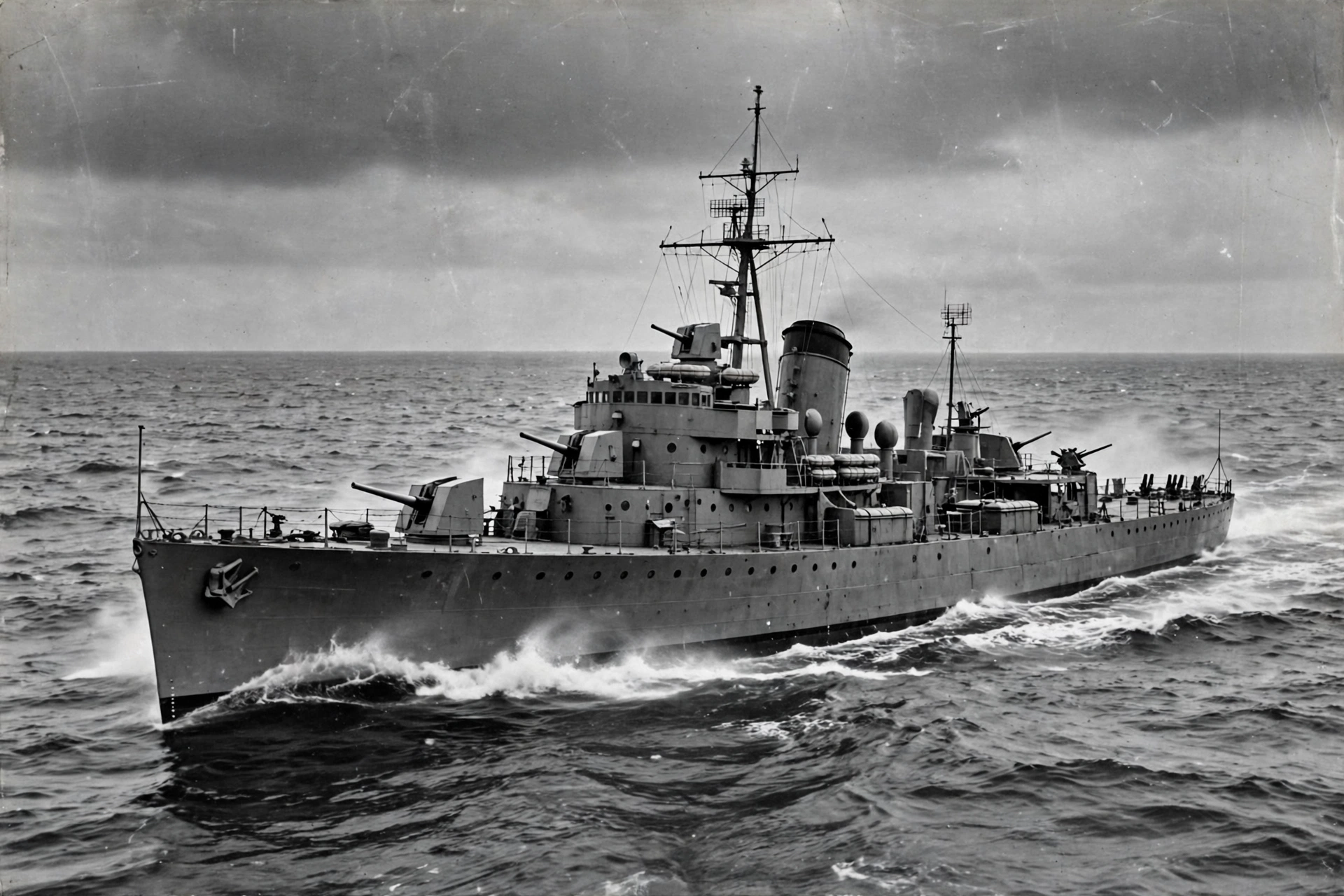
The Eldridge was real: a Cannon-class destroyer escort commissioned in August 1943, built for anti-submarine work in the Atlantic. But its documented movements kill the legend’s premise. Naval records preserved on microfilm show the ship conducting a training cruise far from Philadelphia when the “experiment” supposedly happened. It couldn’t have vanished from a shipyard it wasn’t in. The Eldridge went on to serve through the war, was mothballed, and was later sold to Greece — a thoroughly ordinary career for a supposedly teleported ship.
Who was Carlos Allende, and where did the story come from?

The whole tale runs back to one man. In 1955, Carl Allen — writing as “Carlos Allende” — sent letters to Maurice Jessup, an astronomer who’d written a book on UFOs. Allende claimed he’d watched the experiment from a nearby merchant ship and described the green fog, the vanishing, the mangled crew. He wrote roughly fifty letters, increasingly bizarre, and no other witness or document has ever backed him up. Nearly every detail of the modern legend comes from Allen’s letters, not from any official source.
How one man’s letters became a legend: the annotated book, the Varo edition, and the bestseller
The legend has a paper trail, and it’s short. In late 1955, Carl M. Allen mailed a package marked “Happy Easter” to the U.S. Office of Naval Research: a copy of Morris K. Jessup’s book The Case for the UFO: Unidentified Flying Objects, its margins crammed with handwritten notes in three shades of blue ink — a debate between three people who called each other “Gypsies” and kept circling back to a secret Philadelphia experiment. Only one signed a name: “Jemi.”
In January 1956 Allen began writing Jessup as “Carlos Miguel Allende.” The letters claimed a scientist named Franklin Reno had tested Einstein’s unpublished theories at the Philadelphia Naval Shipyard in October 1943 — and that Allen had watched from the merchant ship SS Andrew Furuseth as the destroyer escort vanished in fog, teleported to Norfolk, and left sailors insane, intangible, or “frozen” in place.
In 1957 two ONR officers — Captain Sidney Sherby and Commander George W. Hoover — took a personal interest and showed Jessup the annotated book. Interest spread: Varo Manufacturing Corporation of Garland, Texas printed 127 mimeographed copies with the annotations and Allen’s letters — the so-called “Varo edition.” Twelve years later, Allen himself admitted he’d written every annotation, he said, “to scare the hell out of Jessup.” Jessup, after losing his publisher and a string of personal setbacks, died by suicide in Florida on April 30, 1959.
The legend’s second life came through retellings: Vincent Gaddis’s 1965 Invisible Horizons, Simpson and Burger’s 1978 novel Thin Air, and — biggest of all — Charles Berlitz (of Bermuda Triangle fame) and William L. Moore’s 1979 The Philadelphia Experiment: Project Invisibility, presented as fact and adding Einstein’s lost theories, Thomas Townsend Brown’s “force fields,” and government cover-ups. Then came the 1984 film directed by Stewart Raffill and Alfred Bielek’s 1989 claim he’d served aboard the Eldridge, repeated at the 1990 MUFON conference. Every retelling traces back to the same source: Allen’s letters.
Key people in the Philadelphia Experiment story
| Person | Role in the story |
|---|---|
| Carl M. Allen (“Carlos Miguel Allende”) | Ex-merchant mariner; his 1955 annotated book and 1956 letters are the legend’s only source |
| Morris K. Jessup | UFO author; recipient of Allen’s letters and the annotated book; died April 30, 1959 |
| Albert Einstein | His unfinished unified field theory supposedly powered the experiment |
| “Franklin Reno” | The alleged scientist — named only in Allen’s letters |
| Capt. Sidney Sherby & Cmdr. George W. Hoover | ONR officers who examined the annotated book in 1957 |
| Austin N. Stanton (Varo Manufacturing) | His company printed the 127 “Varo edition” copies |
| Charles Berlitz & William L. Moore | Their 1979 book The Philadelphia Experiment: Project Invisibility went mainstream |
| Alfred Bielek | Claimed in 1989 he’d served aboard the Eldridge; spoke at the 1990 MUFON conference |
| Thomas Townsend Brown | Navy technician whose “force field” work retellings folded into the legend |
| Charles F. Goodeve | Canadian inventor of the Navy’s real WWII degaussing system |
What was the Navy actually testing in 1943?

Misunderstanding of documented naval experiments
Something real — and the kernel of truth the legend grew around. In 1943, German magnetic mines were sinking Allied ships in the Atlantic. The Navy’s answer was degaussing: neutralizing a ship’s magnetic field so mines couldn’t detect it. The work included installing electromagnetic coils on hulls and “wiping” — dragging 2,000-amp electrical cables along a ship’s sides to alter its magnetic signature. This genuinely made ships “invisible” — to mine sensors, not to human eyes. Philadelphia Naval Shipyard did host this kind of research. It’s easy to see how classified electrical experiments on warships, half-glimpsed and half-understood, could mutate in retelling into invisibility and teleportation.
There’s another documented wrinkle: experiments with the destroyer USS Timmerman‘s higher-frequency generator produced visible corona discharges — strange and eerie to watch, but with no reported effects on the crew. A sailor glimpsing that kind of crackling electrical display through a wartime haze of secrecy wouldn’t need much imagination to start a rumor.
Why won’t the Philadelphia Experiment legend die?
Because it has everything a conspiracy theory needs: wartime secrecy, real classified research, a lone whistleblower, and terrifying imagery. The 1979 book The Philadelphia Experiment: Project Invisibility and the 1984 film gave it mainstream reach, and every retelling adds a layer. Like Area 51 and the Georgia Guidestones, it survives on a perfect recipe — a grain of classified truth, a charismatic origin story, and a public that finds the fantastic version more fun than the degaussing manual.
Claims vs documented evidence
| Believers claim | What the record shows |
|---|---|
| The Eldridge vanished in a green fog on Oct 28, 1943 | Ship logs place the Eldridge in New York waters that day |
| It teleported 250 miles to Norfolk and back | No document or witness corroborates the teleportation |
| Sailors fused into the hull, went insane, burst into flames | The crew’s ordinary wartime service records show nothing of the kind |
| It used Einstein’s unified field theory | Einstein never completed a unified field theory; the physics didn’t exist |
| The Navy covered it all up | The Navy’s classified work was degaussing — real, documented, mundane |
Timeline inconsistencies
The legend keeps tripping over its own calendar. The Eldridge was commissioned on August 27, 1943 and stayed in New York waters into September, so the October “experiment” supposedly happened while she was on her first shakedown cruise in the Bahamas. Believers patch the gap two ways: by claiming the logs were falsified (against the ship’s complete WWII action report and the 1943 deck log, both preserved on microfilm) or by substituting the USS Hammann, which did reach the shipyard on October 20, 1943 — though the Hammann appears nowhere in Carl Allen’s own eyewitness account.
Alternative explanations
Researcher Jacques Vallée points to an entirely mundane candidate: the USS Engstrom, docked alongside the Eldridge in 1943, underwent a procedure that generated a powerful electromagnetic field to deperm and degauss her — making the ship “invisible” to magnetically fused mines and torpedoes. That system, invented by Canadian Charles F. Goodeve and used widely across WWII navies, put crackling electrical gear on a real warship in the very yard the legend points to. Half-glimpsed by the wrong eyes, ordinary degaussing becomes a teleportation experiment in the retelling.
People Also Ask
Did the Philadelphia Experiment really happen?
No. The U.S. Navy says no such experiment was ever conducted, and the USS Eldridge’s logs place it in New York waters on October 28, 1943 — nowhere near Philadelphia. The story traces to the 1955 letters of one man, Carl Allen, and no document or crew member has ever corroborated it.
Was the USS Eldridge a real ship?
Yes. The USS Eldridge (DE-173) was a real Cannon-class destroyer escort commissioned in August 1943. It served through World War II, was later mothballed, and was sold to Greece. Its career was thoroughly ordinary — which is exactly the problem for the legend.
What happened to the crew of the USS Eldridge?
According to the legend, sailors fused into the hull, went insane, or vanished. In reality, nothing unusual happened to them — their service records are normal. Every crew horror story comes from Carl Allen’s letters, not from any official or medical record.
What is degaussing?
Degaussing is the process of neutralizing a ship’s magnetic field so magnetic mines can’t detect it. The WWII Navy used electromagnetic coils and “wiping” — dragging 2,000-amp cables along hulls. It made ships invisible to mine sensors, not to human eyes.
Frequently Asked Questions
Did the Philadelphia Experiment really happen?
No. The Navy denies it, and the ship’s logs contradict the story’s basic premise.
Was the USS Eldridge a real ship?
Yes — a Cannon-class destroyer escort commissioned in August 1943, later sold to Greece.
Who started the Philadelphia Experiment story?
Carl Allen, writing as “Carlos Allende,” in rambling 1955 letters to UFO author Maurice Jessup.
What was the Navy really doing in Philadelphia in 1943?
Degaussing — hiding ships’ magnetic signatures from German magnetic mines.
This article presents traditional beliefs and folklore for informational purposes only, not as proven fact. If you experience persistent distress, please consult a qualified professional.
More CONSPIRACY stories
- Area 51 Secrets: What Is Really Inside
- Georgia Guidestones Destroyed: The Mystery Explained
- Bermuda Triangle Disappearances Explained
The legend’s full history is covered in detail on Wikipedia’s Philadelphia Experiment page, which traces every claim to its sources.