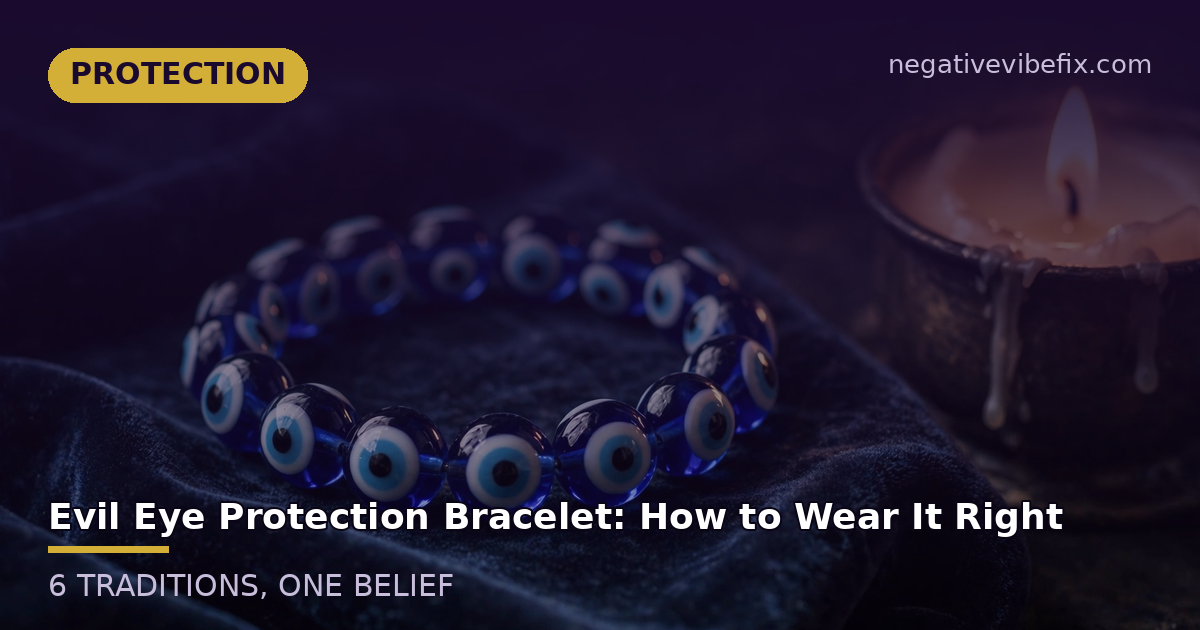
Last updated: 29 October 2026
An evil eye protection bracelet is a small wristband built around the eye-shaped charm that many cultures use to guard against envy and ill will. People wear it for the same reason they hang a charm over a door: as a daily reminder to stay calm, guarded, and aware. This guide covers which wrist to pick, how to activate it, how to clean it, what the colors mean, and what a break really signals.
Quick answer: Wear your evil eye protection bracelet on your left wrist if you follow the most common tradition, cleanse it before the first wear, and set a short, clear intention for protection. Cleanse it monthly, replace it calmly if it breaks, and treat it as a focus tool, not a guarantee.
Key facts
- 6 traditions: Britannica records the evil eye belief in ancient Greece and Rome, and in Jewish, Islamic, Buddhist, and Hindu traditions.
- 3 groups named as most susceptible: pregnant women, children, and animals, according to Britannica.
- 2 wrists, 1 common default: the left wrist is the usual pick; the right wrist is the common alternative.
- 3 classic cleansing methods: salt water, incense smoke, and moonlight.
- 1 rule on a break: tradition reads a break as the bracelet absorbing harm, not as a threat.
What Is an Evil Eye Protection Bracelet?
The evil eye is a belief, recorded across the ancient Mediterranean and Asia, that a jealous or hostile glance can bring harm to the person it falls on. The bracelet turns that old idea into something wearable: a band of beads, cord, or metal, usually centered on a blue-and-white eye bead known in Turkey as nazar boncuğu. In Italy the same worry is called malocchio, and in India it is nazar. The names differ, but the core idea stays the same: an eye that watches back.
Most bracelets pair the eye bead with other materials. Glass beads are the classic choice and the cheapest to replace. Red string bracelets come from a separate custom, often tied on by someone else with a prayer. Beaded bracelets may add black tourmaline, tiger eye, or lava stone for people who also like crystal customs. None of these materials is “the correct one” across every culture. Pick the one that fits your budget, your skin, and the tradition you actually follow.
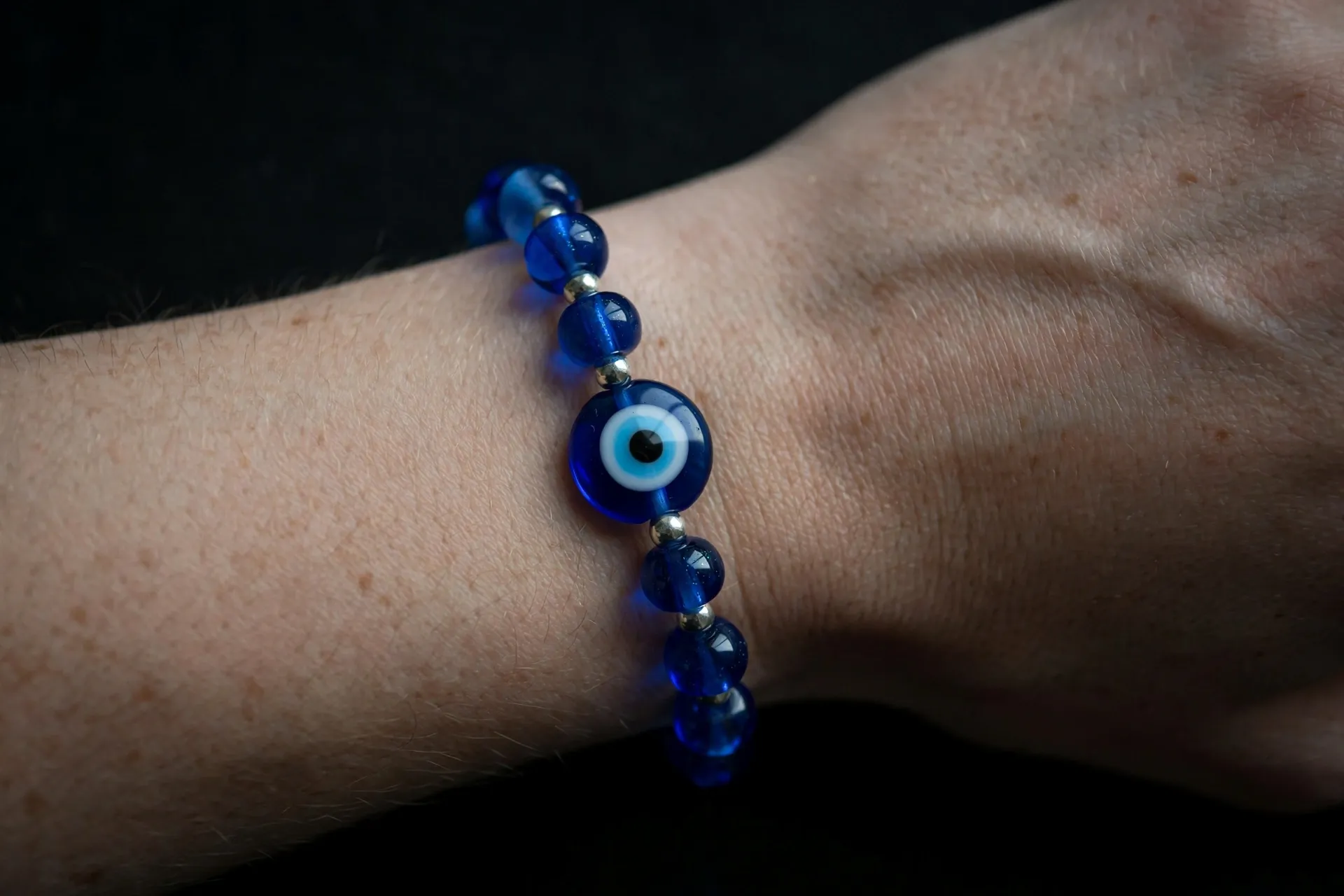
Which Wrist Should You Wear an Evil Eye Protection Bracelet On?
The short answer is the left wrist, if you want the most widely shared custom. In many guides, the left side of the body is linked with receiving energy, so a bracelet there is meant to take in protection. The right wrist has its own logic: it is linked with giving energy out, so some wearers pick it when they want to project confidence or set a firm boundary at work.
Neither choice is wrong, and no tradition punishes you for switching wrists. What matters more is consistency. If you keep moving the bracelet from wrist to wrist, you will fray the cord faster and lose track of whether it still fits. Choose one wrist, wear it there for a few weeks, and only switch if the first choice feels uncomfortable or keeps catching on sleeves and watches. Children usually wear theirs on the left wrist too, tied loosely enough to slip two fingers under the band.
How Do You Activate an Evil Eye Protection Bracelet?
Activation is a short, personal ritual, not a fixed ceremony handed down in one exact form. The steps below pull together the pattern most guides share, so you can follow them in your own words and your own faith.
- Cleanse it first. Rinse it briefly under clean water, pass it through incense smoke, or leave it in moonlight overnight. Skip salt water for metal clasps and delicate cords.
- Hold it and say your intention. Hold the bracelet in both hands and speak one clear sentence, such as “May this guard me from envy and keep my mind steady.” Short and honest beats long and borrowed.
- Add a prayer from your own tradition, if you wish. A Christian wearer might say a short prayer for protection; a Muslim wearer might recite a verse used for refuge; a Hindu wearer might say a short prayer to their chosen deity. The bracelet does not belong to one religion, and the prayer should be one you already trust.
- Wear it the next morning. Put it on with the eye bead facing outward, away from your skin, so the charm “looks out” in the traditional image.

If you already feel affected by envy or a run of bad luck, activation alone is not the whole answer. Our guide to removing the evil eye at home covers salt, smoke, and prayer methods people use first, before they put on a new bracelet.
How Do You Cleanse an Evil Eye Protection Bracelet?
Think of cleansing as washing a tool you use daily. Most wearers cleanse once a month, and sooner after a hard week, a hospital visit, a funeral, or a tense meeting that left them drained. The method should match the material. Glass beads handle a quick rinse well. Leather cords and metal charms do better with incense smoke or a night in moonlight, since water and salt can stain or weaken them.
A simple monthly routine takes under five minutes. Wipe the beads with a soft cloth, pass the bracelet through incense smoke three times, and set it on a windowsill overnight. If you prefer salt, use dry salt in a bowl rather than soaking the whole bracelet, then brush the salt off. After cleansing, hold the bracelet for a few seconds and repeat your original intention. That small pause is what turns cleaning into a ritual, rather than just a chore.
What Do Evil Eye Bracelet Colors Mean?
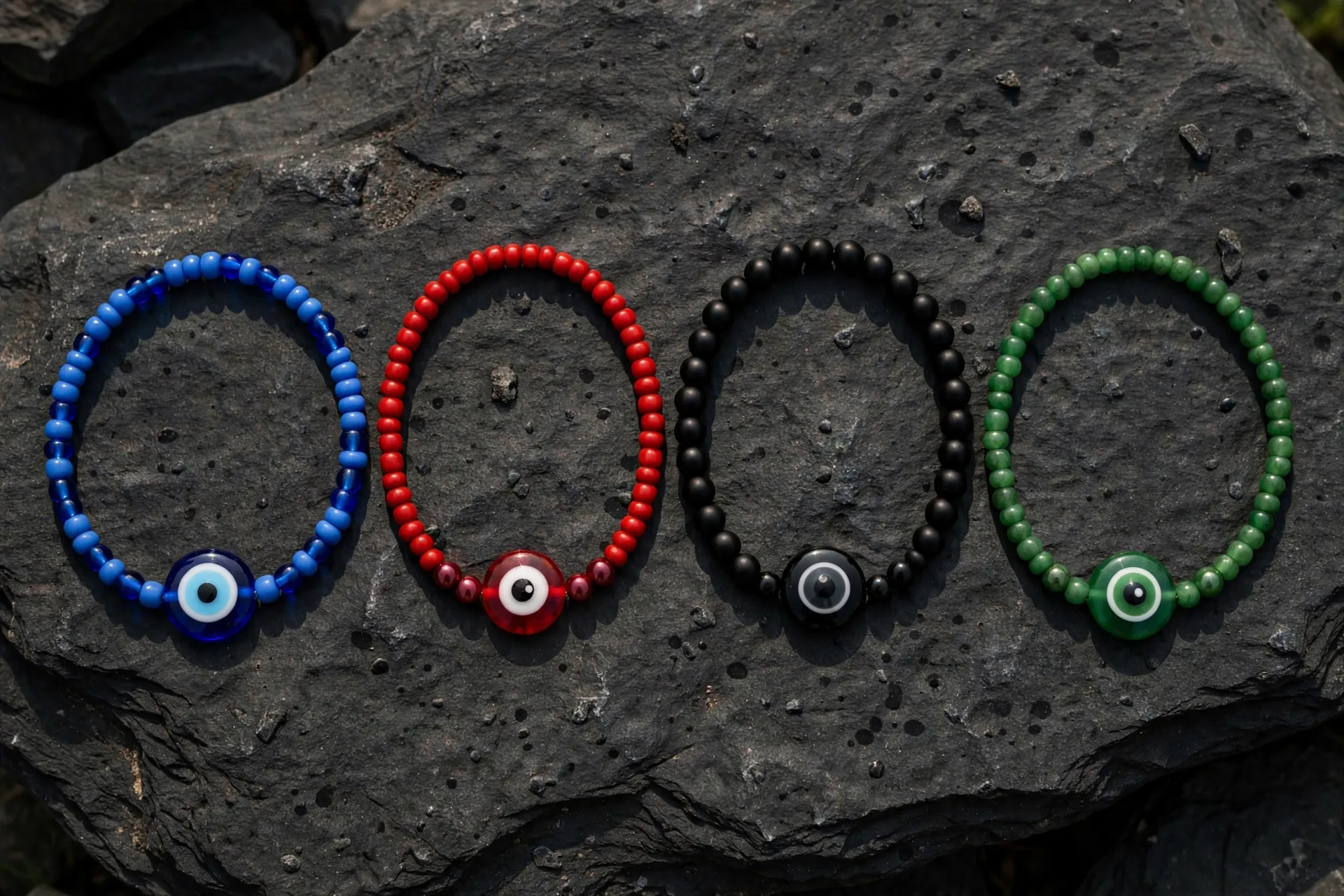
Color meanings vary by seller and region, so treat this table as the most common modern reading, not an ancient code. Blue is the classic choice in every tradition. The rest are popular add-ons that let wearers match the bracelet to a personal goal.
| Color | Common meaning | Best for |
|---|---|---|
| Dark blue | Protection and calm | Daily wear, the classic pick |
| Light blue | Peace and clear thought | Stressful workdays |
| Red | Courage and energy | Confidence, new ventures |
| Black | Grounding and boundaries | People who absorb others’ moods |
| Green | Growth and balance | Health goals, new chapters |
| White | Clarity and fresh starts | Children, new homes |
Black beads pair well with stones like black tourmaline, which many wearers pick for the same grounding reason. See our guide to black tourmaline for protection if you want a bracelet that mixes the eye bead with a stone. When you buy, check the cord first: a strong, well-knotted cord matters more than a rare color, because a bracelet that snaps in a week protects no one.
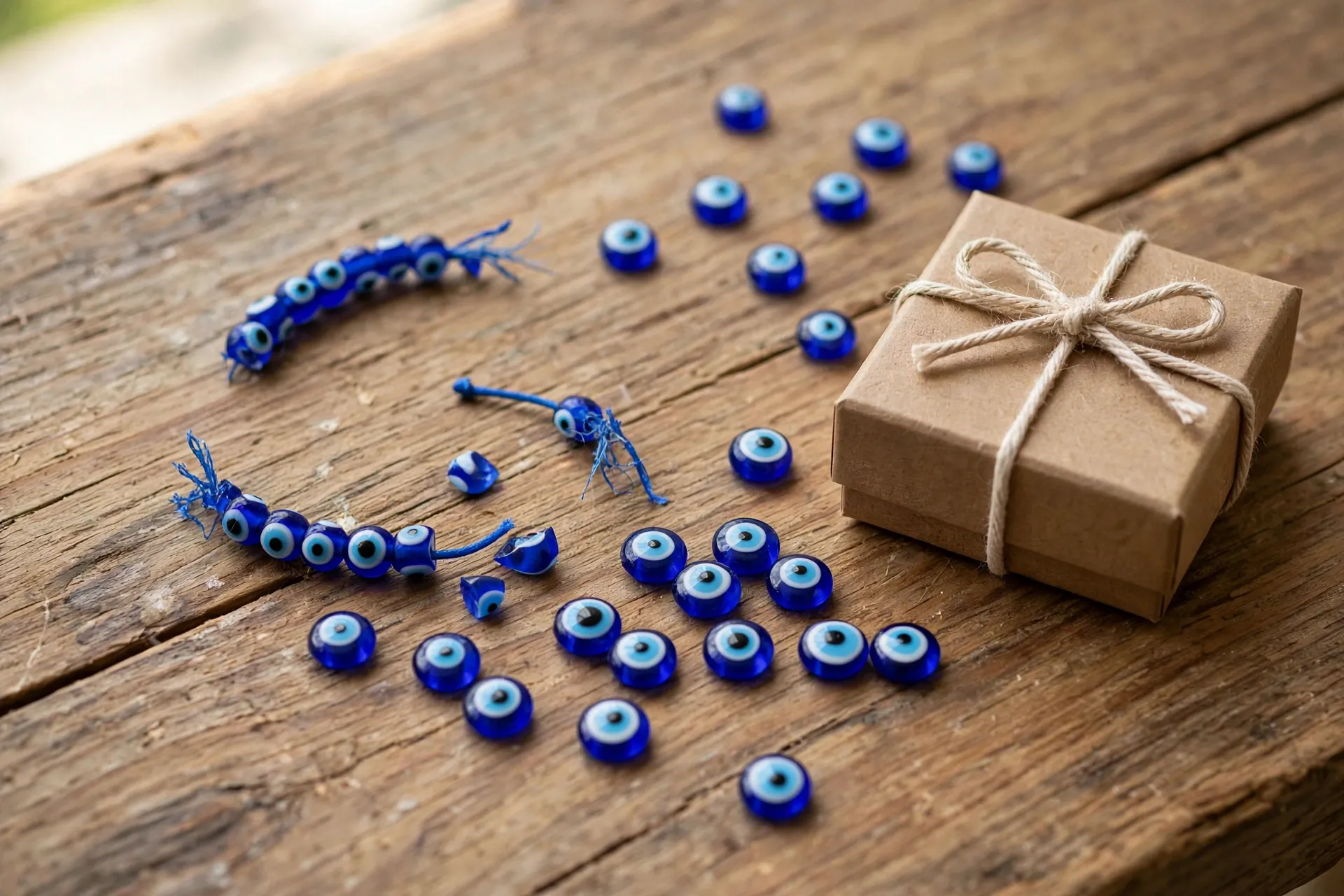
What Should You Do If Your Evil Eye Protection Bracelet Breaks?
Do not panic. In tradition, a bracelet that breaks has absorbed a strong dose of negative energy meant for you, and breaking is how it releases that load. Thank it in your own words, gather the beads, and dispose of them respectfully: bury them, drop them in running water where that is allowed, or simply wrap them and bin them if no other option fits your life. Then take a day or two before you replace it, and check whether the cord was simply worn out. Most breaks are wear and tear, not a warning.
Gifting rules are simple and worth knowing. Many families say a gifted bracelet carries more weight than one you buy for yourself, because the giver’s good wish is part of the gift. If you give one, tie it on the other person’s wrist yourself when you can, and say your wish aloud. If you receive one, accept it with thanks and wear it as given, even if the color is not your first pick. For a home that needs wider cover than one wrist, a protection spell jar is the usual next step people pair with a bracelet.
A clear-eyed note belongs here too. There is no scientific proof that a bracelet blocks envy or changes events, and Britannica itself frames the evil eye as a belief, not a measured force. What the bracelet can do is real in a different way: it slows you down each morning, reminds you of a boundary you set, and gives you a small ritual when a week feels hostile. Pair it with practical steps — rest, honest talks, and help from a professional when distress persists — and it works as a focus tool, not a substitute for them. For the wider background, see Britannica’s overview of the evil eye.
Which Type of Evil Eye Protection Bracelet Should You Choose?
Shops sell the same eye charm in very different builds, and the build decides how long it lasts. A glass bead bracelet is the classic Turkish and Greek style: bright, light, and easy to replace. A natural stone bracelet pairs the eye charm with hematite, tiger eye, black tourmaline, or lava stone, and suits wearers who like a heavier feel. A red thread or cord bracelet is the lightest option and the one most often tied on by someone else. A metal bracelet, usually silver-toned or gold-toned with a small eye charm or pendant, lasts longest but costs more and can irritate sensitive skin.
| Type | Feel and fit | Watch out for |
|---|---|---|
| Glass bead, elastic cord | Light, stretchy, easy daily wear | Elastic weakens with water and heat |
| Natural stone, e.g. hematite | Heavier, cool to the touch | Stone beads can chip if dropped |
| Red thread or cord | Soft, adjustable, minimal | Frays faster; keep it dry |
| Metal charm bracelet | Sturdy, dressy, long-lasting | Check for nickel if your skin reacts |
Men’s styles tend to use darker beads, larger stones, and leather or hematite, while women’s styles often use smaller glass beads, silver charms, and pastel cords — but these are shop labels, not rules. Choose by wrist size and comfort, not by the label on the listing. A bracelet made for men or for women works the same way in tradition; only the fit differs.
How Do You Pick the Right Size and Spot Good Quality?
Measure your wrist with a soft tape, then add about 1 to 1.5 centimeters for a comfortable beaded fit, or about 0.5 centimeters for a snug cord fit. An adjustable bracelet with a sliding knot suits most wrists and survives small size changes. If you buy elastic, check that the beads sit close without gaps when the band is relaxed; gaps mean the elastic is already tired. Good glass beads have a clean eye pattern — a sharp dark center, an even white ring, and a smooth surface with no bubbles trapped in the blue. Handmade beads vary slightly, and small variation is normal, but cloudy glass, rough edges, or a painted eye that flakes off are signs of a poor piece. Keep the receipt and the seller’s return terms until you have worn it for a week, so a faulty clasp or cord can be exchanged.
Evil Eye Protection Bracelet Buying Checklist
Before you pay, read the listing the way you would read any jewellery listing. Sellers describe the same bracelet in very different words, so check the material first: stainless steel and sterling silver hold up best for daily wear, while 18K gold plated pieces look dressier but need gentler care. An anti-tarnish coating helps a plated charm keep its shine, but no coating lasts forever, so ask how the seller handles tarnish under warranty. Check whether the bracelet is described as waterproof or only water-resistant, and take it off for swimming either way if the cord is elastic or thread. Magnetic clasps suit people who struggle with small clasps, while an adjustable sliding knot suits growing children and gift buyers who do not know the wrist size. Finally, look for a clear return policy and a size chart in centimeters, not just “one size fits all,” and prefer handmade listings that show the actual bead pattern in photos rather than a stock image.
Evil Eye Bracelet Materials Compared
Shops use the same eye charm on very different bases, and the base sets the price, the weight, and how you care for it. Glass is the classic Turkish and Greek bead: light, bright, and cheap to replace. Hematite is a dark grey stone with a metallic shine, often paired with black onyx in men’s bracelets, and it feels much heavier on the wrist. Gold-plated brass, such as a 22kt gold-plated piece, looks dressy and usually comes in a hypoallergenic, nickel-free finish, but the plating fades with rough use. Sterling silver and stainless steel cost more and hold up best for daily wear.
| Material | Feel and price band | Care note |
|---|---|---|
| Glass eye bead | Light, lowest price | Chips if dropped; painted eyes can flake |
| Hematite and black onyx | Heavy, mid price | Stone beads can chip; keep dry where the closure is magnetic |
| Gold-plated brass | Dressy, higher price | Plating fades; ask about re-plating and warranty terms |
| Sterling silver or steel | Sturdy, higher price | Check nickel content if your skin reacts |
| Cubic zirconia accents | Bright sparkle on gold-toned pieces | Clean with a soft cloth; skip harsh chemicals |
What Should You Pay, and How Do You Check Authenticity?
In India, the listings ranking for this keyword in late October 2026 run roughly from ₹999 for a natural-stone bead bracelet to about ₹2,999 for a gold-plated piece. Material drives most of that gap, followed by certification, warranty length, and brand. A lab certificate is the clearest authenticity check for stone bracelets: some sellers include a certificate with a batch number you can verify on the lab’s own page, which is a stronger signal than a bare “natural stone” claim. For glass beads, check the eye pattern itself, since a sharp dark center and an even white ring mark a well-made bead.
Before you pay, confirm three practical points. First, the closure: a magnetic clasp suits people who struggle with small clasps, an adjustable slider suits gift buyers who do not know the wrist size, and plain elastic needs replacing sooner. Second, the return terms: a 7-day return window and a 6-month warranty on clasps and breakage are common on established Indian sellers, and cash on delivery is widely offered. Third, the size chart: pick from a chart in centimeters, not from “one size fits all,” and use the extender or slider to fine-tune the fit.
People Also Ask
Can you wear an evil eye protection bracelet with a watch?
Yes. Wear the bracelet on the opposite wrist from your watch if the beads scratch the watch face, or stack it on the same wrist with the eye bead on top. Comfort and cord life matter more than a strict placement rule.
Should you take off an evil eye protection bracelet at night?
Most wearers keep it on, but take it off if the cord is tight, the beads press into your skin, or you sleep restlessly. A bracelet left on a bedside table overnight still counts as yours, and it will be there in the morning.
Can children wear an evil eye protection bracelet?
Yes, and in many traditions children are the main wearers, since belief holds they are more open to envy. Use a soft cord, a loose fit, and no small beads for babies or toddlers who might chew or swallow them.
Does a gifted evil eye protection bracelet work better than one you buy?
Tradition says yes, because the giver’s wish is part of the gift. In practice, a bracelet you pick yourself with a clear intention serves the same purpose. The wish matters; the shop receipt does not.
More Protection stories: How to Remove Evil Eye at Home Instantly: 7 Methods | Black Tourmaline for Protection: Meaning, Benefits & How to Use | Protection Spell Jar: How to Make One for Your Home
This article presents traditional beliefs and folklore for informational purposes only, not as proven fact. If you experience persistent distress, please consult a qualified professional.
1 thought on “Evil Eye Protection Bracelet: How to Wear It Right (2026)”