Last updated: 12 November 2026
Spoiler warning: this is a full Backrooms movie ending explained, so every twist below gives the plot away. Kane Parsons’ A24 film premiered on 7 May 2026, reached US cinemas on 29 May 2026, and started streaming on HBO Max on 25 September 2026. Since then, one question has filled search boxes on both sides of the Atlantic: what did that ending actually mean?
Quick answer: Clark dies. His distorted copy, Pirate Clark, kills him in the final act, but Mary fights back with a piece of concrete from her childhood home and is rescued by Async researchers. The last shot shows a deformed copy of Mary sitting in a fake interrogation room, so the film never confirms whether the real Mary is free.
Key stats
- US theatrical release: 29 May 2026, after a 7 May 2026 premiere at the Aero Theatre in Santa Monica.
- Runtime: 110 minutes. Director: Kane Parsons, in his feature directorial debut. Studio: A24.
- Streaming: HBO Max from 25 September 2026.
- Cast: Chiwetel Ejiofor as Clark, Renate Reinsve as Dr. Mary Kline, Mark Duplass as Async researcher Phil.
- Origin: a 2019 4chan creepypasta post, then Parsons’ found-footage web series from 2022.
- Searches for the ending broke out across Italy, Mexico, Ireland and the UK in November 2026, months after release.
Backrooms Movie Ending Explained: What Happens in the Final Act
The final act starts with Mary walking into the yellow rooms to find her patient. Clark has been missing for weeks, and the man she finds is no longer the man she was treating. He knocks her out, ties her to a chair in a room that looks like a dining room, and keeps her there with three grotesque, barely moving figures. These are Still Lifes, and Clark uses them to explain what he thinks the Backrooms are.
Then the film turns. A towering copy of Clark himself appears, dressed as the pirate mascot from his old furniture-store commercial. Clark calls him Captain Clark. The pirate kills Clark, then hunts Mary through a chain of warped rooms until they reach a flawed copy of Clark’s furniture store. Mary fights back with a chunk of concrete from her childhood home, a piece she finds in her pocket. The struggle sets off an Async gas trap, and researchers in hazmat suits step in, subdue the creature and carry Mary out.
The last stretch is quiet. Mary is taken to an Async facility and questioned by Phil, a researcher who acts friendly while making it plain that her release is not his call. The film closes on a montage of Backrooms copies of real places, ending in a replica of the interrogation room. A deformed, multi-faced copy of Mary sits there, still and silent. Cut to black.
What Are the Backrooms, Really?
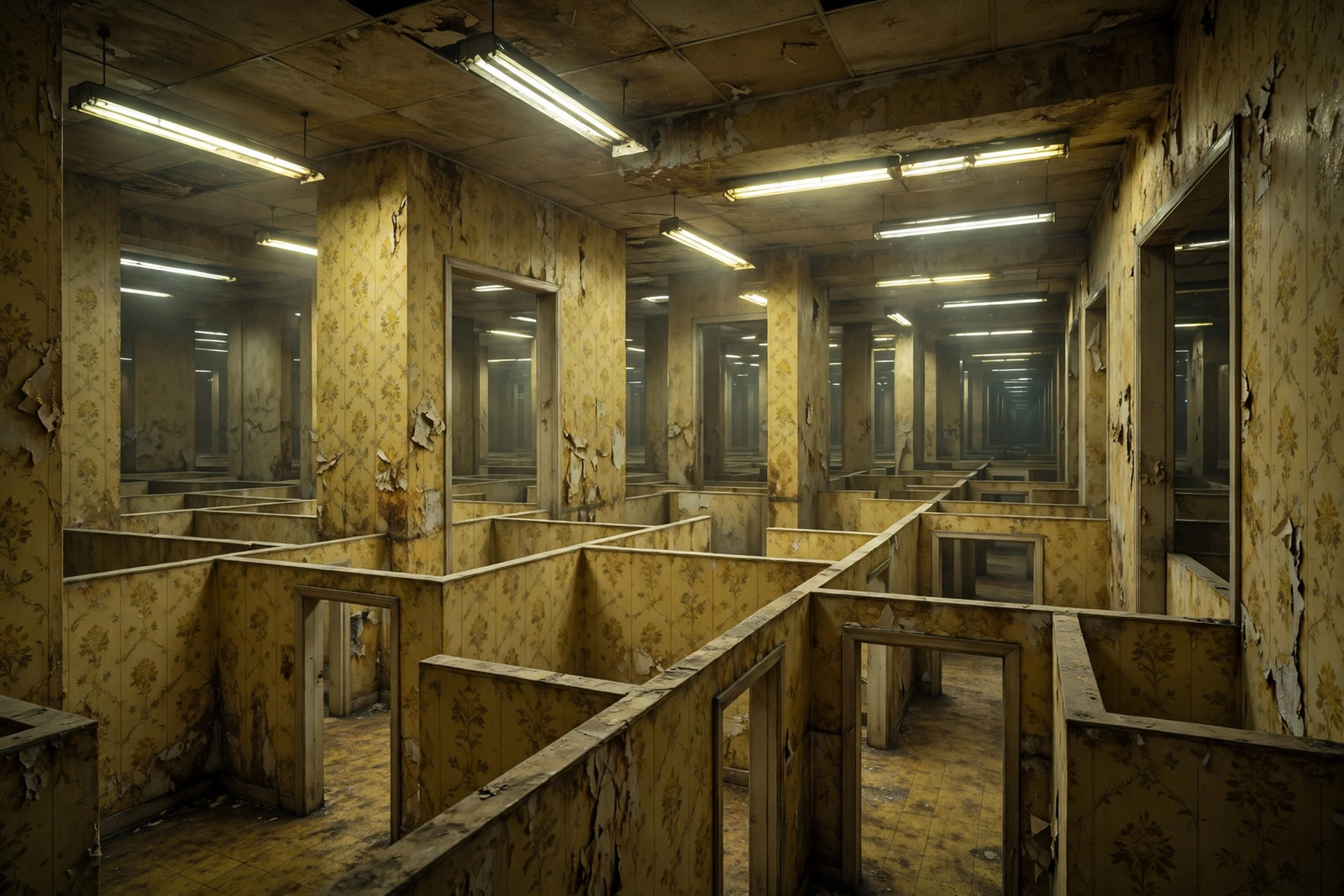
Clark gives the only theory the film offers, and he gives it while clearly losing his grip: the Backrooms are “every place that ever was.” In his words, the place works like a memory store for the real world. Every room, street and home that has ever existed has a copy here. As living memory of a place fades, its copy loses detail, until nothing is left but yellow walls, damp carpet and buzzing lights.
That is why the rooms feel wrong in small ways. They are copies made by something that remembers places badly. A dining room is almost a dining room. A furniture store is almost a furniture store. Each time the Backrooms “remembers” a place, the copy comes out a little more bent.
Two points matter here. First, the theory comes from Clark, not from the film itself. He is tired, frightened and half-mad when he says it, so the audience is meant to hold it lightly. Second, nothing else in the film contradicts it. The rooms Mary walks through behave exactly as Clark describes: familiar, then less so, then barely anything at all.
What Are the Still Lifes?
The Still Lifes are the film’s most disturbing idea, and the one viewers ask about most. Each one is a copy of a real person, made the way the Backrooms misremember them. They look human at a glance, then wrong in every detail: stretched, sagging, still. Clark shows Mary that they feel no pain and have no conscience. They just exist, and their only job seems to be keeping people from leaving.
Clark also shows her something worse. The figures are made of an edible white substance, and he treats eating one as normal. The fridge in the room holds Kat’s severed head, a blunt reminder that his two employees never made it out. The scene lands because it is matter-of-fact. Clark is not boasting. He has simply lived with these things long enough to stop seeing them as shocking.
Most Still Lifes are passive. Captain Clark is the exception. He moves, he rages, and he seems to hold a grudge, as if he resented Clark for bringing Mary, the therapist who dug up all his pain, into his home. That extra awareness is the first hint that the Backrooms do not copy everyone the same way.
What Happened to Clark in the Backrooms?

Clark was a failed architect working as a furniture salesman, divorced, drinking, and sleeping in his own store after his wife threw him out. He found a portal through a solid wall in the store and told Mary about it. When she did not believe him, he went back in with his two employees, Kat and Bobby, to map the place. Both died there. Clark stayed.
Weeks inside the maze stripped away what was left of him. By the time Mary finds him, he is an unhinged mirror of himself, driven by the same insecurity, anger and fear Mary had been trying to treat. The Backrooms did not put those flaws in him. It gave them a shape and a place to grow.
That shape is Pirate Clark, a huge, bent version of Clark in a pirate costume from his store’s old commercial. Parsons has described the Backrooms as a feedback loop of Clark’s inner world, “vomited out onto the walls.” Pirate Clark is that loop wearing a face. When Clark accepts the creature, even embraces it, the copy bites through his neck and kills him.
Parsons has refused to pin the death down to one meaning. He told Polygon that Clark’s state of mind was the key to it, then added that it “very well could be that Clark was just feeling especially hungry that day.” The film leaves it there: a man eaten by the worst version of himself.
Did Mary Actually Escape the Backrooms?
Mary survives, and that is the one clear fact in the ending. After Captain Clark corners her in the copy of the furniture store, she hits him with the concrete handprint she made with her mother as a child. The fight trips an Async gas trap. Hazmat-suited researchers subdue the creature and carry Mary through the Threshold, the door Async opened between our world and the Backrooms.
But surviving and escaping are not the same thing here. Mary wakes up in an Async facility, not at home. Phil questions her gently, even role-playing the therapy sessions she used to run with Clark, but he never says she can leave. He tells her that doors into the Backrooms are appearing everywhere and that Async is trying to work out why. She is a witness, a test subject, or a prisoner. The film does not pick one.
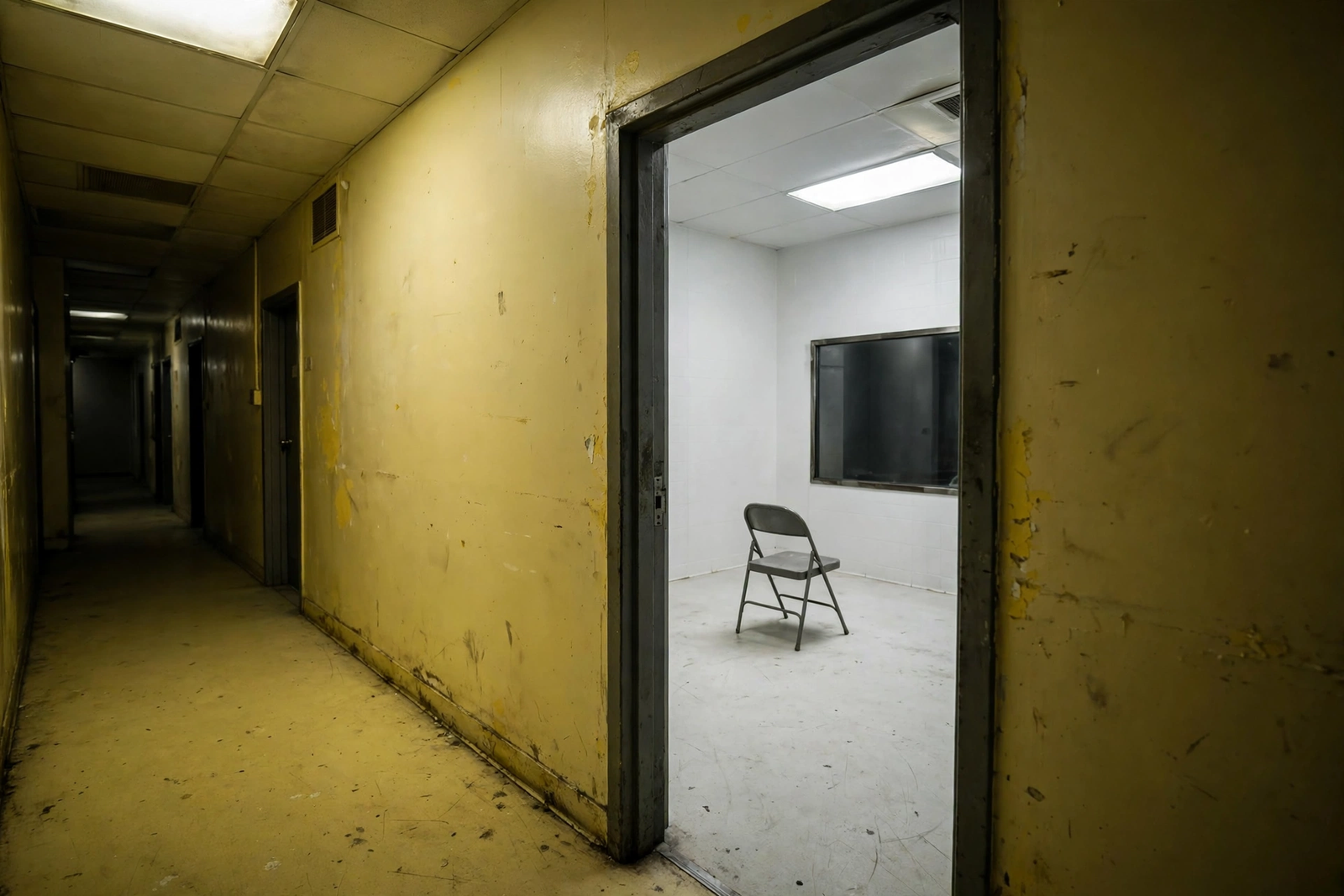
Then comes the final image. After the interrogation, the film cuts to a montage of Backrooms versions of real places, and the last one is a copy of the interrogation room itself, with a deformed Still Life version of Mary sitting in it. Two readings fit, and any honest Backrooms movie ending explained has to hold both at once. One: Mary did escape, and the shot simply shows how the Backrooms work, making a copy of everyone who passes through. Two: she never left, and the interrogation was the Backrooms copying her life back at her. Parsons has confirmed the events were real inside the story, telling Esquire “it wasn’t a dream,” but he has kept his own reading of the ending private.
Mary’s own history makes the second reading sting. As a child, her mother, who lived with paranoid schizophrenia, kept her locked inside the house and never let her look out a window. Her mother was later placed in a psychiatric facility, something Mary hints she helped bring about. Mary ends the film locked in a facility again, this time under the guise of being cared for. She broke one cycle in the Backrooms and walked straight into another.
What Is Async Hiding?
Async is the company that ties the film to Parsons’ web series. In the film’s lore, Async used to make MRI machines until it found the Backrooms, and the maze has been its main research focus ever since. In the web series, its researchers in hazmat suits and its found-footage tapes are the backbone of the story. In the film, Async barely appears until the last twenty minutes, and that delay is deliberate.
What we learn is thin and worrying. Async has mapped parts of the maze. It has caught at least one Still Life and keeps it under study. Its cameras sit in specific rooms, linked to the caveman cutouts that play greeting recordings inside the Backrooms. And Phil admits that new doors are opening on their own, all over the world, for reasons Async does not understand.
None of that is a full answer, and that is the point. The film uses Async the way the web series does: a company that knows more than it says and says less than it knows. Phil is polite, patient and unreadable, played that way on purpose. The ending sets up a sequel without promising one, and the cleanest thread for a follow-up is Mary inside Async, not Mary back in the maze. That open thread is exactly why a Backrooms movie ending explained cannot end with a neat verdict.
Is the Backrooms Movie Based on a True Story?
No. The film is fiction from start to finish. It began as a 2019 4chan post: a photo of empty yellow rooms with a short piece of writing about no-clipping out of reality. Parsons, then a teenager making videos as Kane Pixels, turned that post into a found-footage web series in 2022. A24 saw the series and hired him to write and direct the feature version. The film’s production history is documented on Wikipedia, from the web series to the A24 release.
What is real is the feeling the film borrows. Liminal spaces, empty offices, malls after closing, hotel corridors at 3 a.m., are real places, and the film’s look copies them closely. That is why the rooms feel familiar even though the story is invented. Some horror films do grow from real cases, like the Annabelle doll case or the Verónica case from 1991, but Backrooms is not one of them. Its roots are an internet ghost story, not a police file.
What Has the Director Said About the Ending?
Parsons has talked about the ending more than most directors would, and still refused to explain it. Speaking to Polygon, he called the Backrooms an echo chamber for Clark and a feedback loop of his inner world. He confirmed the events happened inside the story, telling Esquire “it wasn’t a dream.” Then he drew a line: “I am a little averse to explaining the events in the work I do. I swear I don’t want that to seem like a cop-out. It’s just, my audience loves to defer to my word over their own interpretations. I want to be careful, anything I say will be taken so seriously.”
He said the same about Pirate Clark’s motives. Asked why the copy kills Clark, he pointed to Clark’s state of mind, then admitted there may be no reason at all, because “we don’t get a monologue from Pirate Clark.” Asked whether the copy could keep changing to mirror other people, he refused to answer: “I can’t comment on that, unfortunately. That’s something I got to protect for the future.”
That last line is the closest thing to a sequel hint on record. Parsons is guarding ideas about how the Backrooms work, which only matters if he plans to use them again.
How the Movie Compares to the Web Series
| Detail | Web series (2022) | Film (2026) |
|---|---|---|
| Format | Found-footage YouTube shorts | 110-minute A24 feature film |
| Main focus | Async researchers and lost explorers | Clark and his therapist Mary |
| Async’s role | Central, shown from the start | Held back until the final act |
| The Backrooms | Mostly unexplained | Clark’s “every place that ever was” theory |
| Ending | Open, spread across episodes | One ambiguous final shot |
The film sits in the same universe as the series but tells a self-contained story. Viewers who know the series will spot Async, the Threshold door and the hazmat teams. Newcomers lose nothing: the film explains what it needs to, and leaves the rest as mystery.
Where to Watch Backrooms Now
Backrooms opened in US cinemas on 29 May 2026 after its 7 May premiere, and it began streaming on HBO Max on 25 September 2026. That streaming date is what pushed the ending back into search trends in the autumn, and why a fresh Backrooms movie ending explained is suddenly in demand: viewers who missed the cinema run met the film at home and went looking for answers the same night. If you have not seen it yet, watch it before reading the sections above. The ending works best when the last shot lands without warning.
Backrooms Movie Ending Explained: Your Questions Answered
Does Clark die in the Backrooms movie?
Yes. Captain Clark, the towering pirate-costumed copy of Clark, kills him in the final act by biting through his neck. Clark accepts the creature first, which is what makes the death land: the copy is the worst version of Clark himself, shaped by his guilt, anger and refusal to face his failed marriage. Parsons has said the death grew from Clark’s state of mind and will not give it one fixed meaning.
Did Mary actually escape the Backrooms?
She gets out alive, rescued by Async researchers, but the film never confirms she is free. Phil questions her in an Async facility and never promises her release, and the last shot shows a deformed copy of Mary in a fake interrogation room inside the Backrooms. The honest answer is that she escaped the maze, not necessarily Async, and the film leaves the rest open on purpose.
Is the Backrooms movie based on a true story?
No. It is fiction built on a 2019 4chan creepypasta post, which Kane Parsons turned into a web series in 2022 before A24 backed the feature film. No real event or place sits behind the story. What feels real is the setting: the yellow rooms copy the look of actual empty offices, malls and corridors, which is why the film feels familiar even to first-time viewers.
Will there be a Backrooms 2?
No sequel has been announced. The ending leaves plenty of room for one, though: Async is studying the Backrooms, doors are appearing everywhere, and Mary is in their custody. Parsons has said he is protecting some ideas about the Backrooms for the future, which fans read as a sign he may return to it. Until A24 says otherwise, a sequel is a strong possibility, not a promise. Horror films that leave a door open for a follow-up are nothing new, as our breakdown of Other Mommy shows.
More Horror Movie Stories
- Other Mommy Explained: True Story or Not?
- Annabelle Doll True Story: 1970 Case vs the Conjuring Film
- The Girl Who Played With the Ouija Board: Verónica (1991)
Questions or corrections about this article? Reach us through the contact page.
This article presents traditional beliefs and folklore for informational purposes only, not as proven fact. If you experience persistent distress, please consult a qualified professional.