
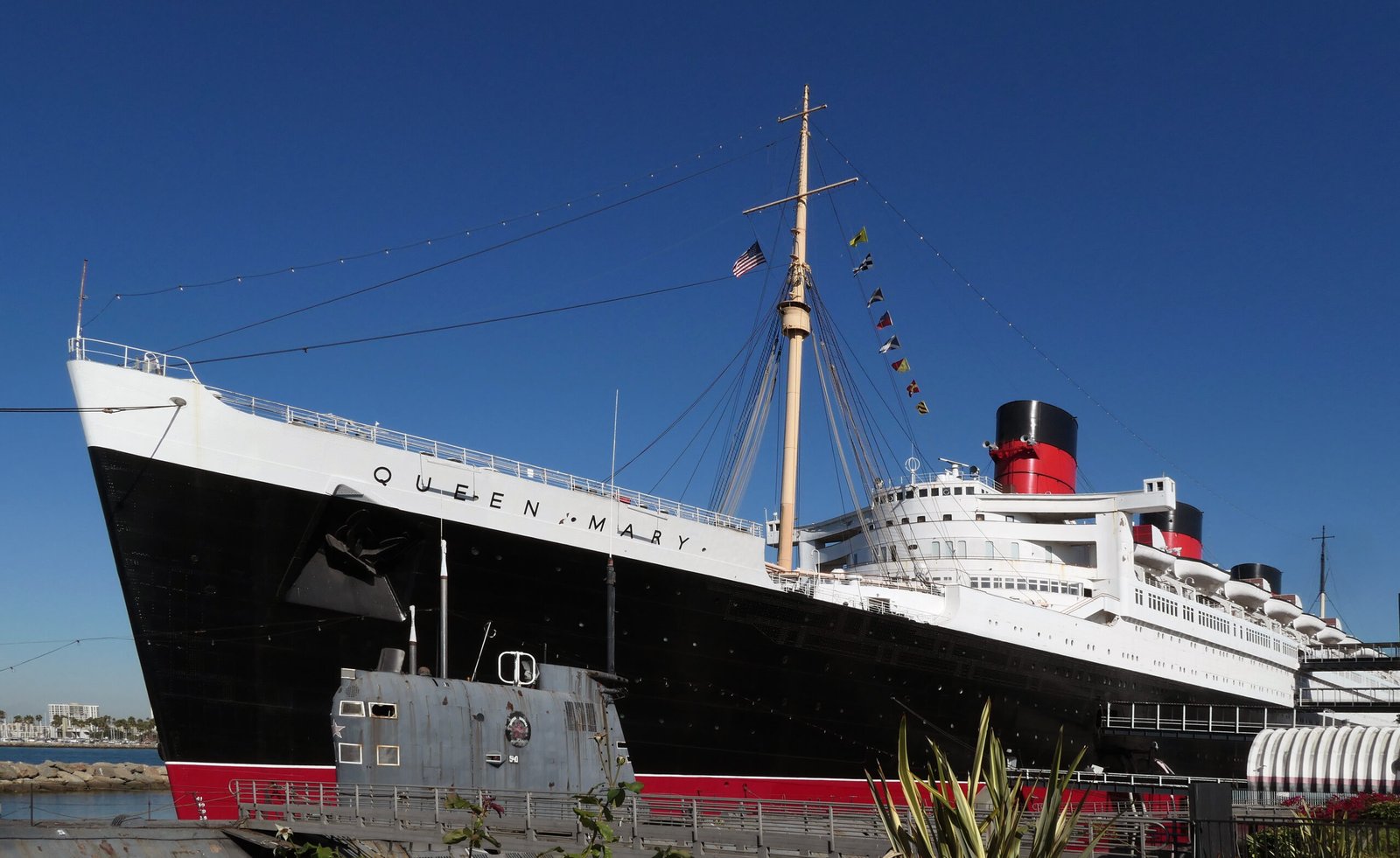
Is the Queen Mary really haunted? She is one of the most famous ocean liners ever built — a 1930s art-deco giant that carried royalty, wartime troops, and Hollywood stars. Today she sits permanently docked in Long Beach, California, as a hotel and museum. And she has more reported Queen Mary ship ghosts than almost any place in America: a haunted stateroom closed for 30 years, a drowned little girl in the drained pool, and a young crewman still walking the engine room. Here’s the lore, the history behind it, and what the reports actually prove.
Last updated: October 24, 2026
- Maiden voyage: 27 May 1936 (Southampton to New York); retired 1967
- Size: 81,237 gross tons, 1,019 feet long — the first British liner over 1,000 feet
- Transatlantic crossings: 1,001 between 1936 and 1967; about 2.2 million passengers carried
- WWII: the “Grey Ghost” troopship, carrying up to 15,000 troops at a time
- Deaths aboard: about 49–50 reported during her sailing years
- Today: floating hotel and museum, docked in Long Beach since 9 December 1967, on the National Register of Historic Places
What is the Queen Mary? The RMS Queen Mary is a retired British ocean liner, launched in 1934 and in service from 1936 to 1967, now permanently moored in Long Beach, California, as a hotel, museum, and one of the world’s most reported-haunted places.
What is the history of the Queen Mary ship?
The historical journey of the Queen Mary
Built by John Brown & Company in Clydebank, Scotland, the Queen Mary was launched in 1934 and made her maiden voyage on 27 May 1936, sailing from Southampton to New York via Cherbourg. At 81,237 gross tons and 1,019 feet, she was the first British liner over a thousand feet long. Over 31 years she made 1,001 transatlantic crossings and carried about 2.2 million passengers — royalty, movie stars, and heads of state among them.
World War II begins: the Grey Ghost
When war broke out in September 1939, the ship was stripped of her finery, painted grey, and turned into a troopship — earning the nickname “Grey Ghost.” She could carry up to 15,000 troops at a time and set a record of 16,683 people aboard a single voyage in 1943. In total she transported roughly 810,000 service members. Her speed — over 28 knots — let her outrun U-boats, and she was never seriously attacked.
| Date | Event |
|---|---|
| 1934 | Launched at Clydebank, Scotland |
| 27 May 1936 | Maiden voyage: Southampton to New York |
| 1939–1945 | Serves as the “Grey Ghost” troopship in WWII |
| 2 Oct 1942 | Collides with HMS Curacoa; 337 of the cruiser’s crew die |
| 1948 | Passenger Walter J. Adamson dies in stateroom B340 |
| 10 Jul 1966 | Crewman John Pedder, 18, is crushed by watertight Door 13 |
| 9 Dec 1967 | Arrives in Long Beach; retired from service |
| 1993 | Listed on the National Register of Historic Places |
| 2018 | Room B340 reopens after ~30 years closed |
| 2020–2023 | Ship closed for extensive repairs; reopens to visitors |
The ship’s historic status is official: she was added to the National Register of Historic Places in 1993, with the nomination papers held by the U.S. National Park Service.
Is the Queen Mary haunted?
Haunting legends and ghost stories
Nobody can prove a ship is haunted — but the Queen Mary’s reports are unusually numerous. One ghost-tour company claims up to 150 spirits linger aboard, and guides have catalogued over a hundred “hot spots.” Guests describe faucets turning on by themselves, sheets pulled off beds, wet footprints with no one around, and figures in period clothing that vanish.
| Haunted spot | What’s reported | The real history behind it |
|---|---|---|
| Stateroom B340 | Shadow figures, faucets running, sheets pulled off | Passenger Walter J. Adamson died here in 1948; room closed ~30 years |
| First-class pool | Wet footprints, children’s laughter, figures in 1930s swimwear | Pool drained decades ago; “Jackie” drowning story is unverified |
| Door 13, engine room | Young man in blue overalls, metallic clanging | John Pedder, 18, crushed by the door on 10 Jul 1966 |
| Queen’s Salon | Woman in white dancing near the piano | Former first-class lounge; her identity is unknown |
| The bow | Screams, the sound of crushing metal | HMS Curacoa collision, 2 Oct 1942 — 337 crew died |
What gives the stories weight is that many trace back to real, documented events: a fatal wartime collision, an 18-year-old crushed by a watertight door, a passenger who died in a stateroom.
Who is the ghost of Room B340?
Stateroom B340 is the Queen Mary’s most famous haunted room. What we know for sure: in 1948, a third-class passenger named Walter J. Adamson died in his sleep in that room. Afterward, guests reported shadow figures at the foot of the bed, covers pulled off sleepers, faucets running on their own, and doors opening and closing.
The hotel took the room out of service for about 30 years because of the reports. It reopened — after a renovation — on Friday the 13th of April 2018, leaning into the legend with tarot cards, a crystal ball, and guest accounts written on the walls. It reopened for reservations again in September 2024.
Be careful with the wilder stories: the tales of murders in B340 — a man killing two women, a wife killing her husband — have no documentary basis and are acknowledged as urban legend. The documented death is Adamson’s; everything else is folklore.

What happened at the first-class swimming pool?
The grand first-class pool — drained for decades now — is called the heart of the hauntings by some investigators. Reports include wet footprints with no one around, the sound of splashing and children’s laughter, and figures of women in 1930s bathing suits.
The pool’s best-known legend is Jackie, a little girl said to have drowned there, whose giggling has been reported nearby. Another figure, called Sarah, wears a striped old-fashioned bathing suit. These are tour traditions — no published death records confirm them. Like so many of the world’s most haunted places, the pool stories are carried by witnesses, not by archives.
Who was John Pedder, the ghost of Door 13?
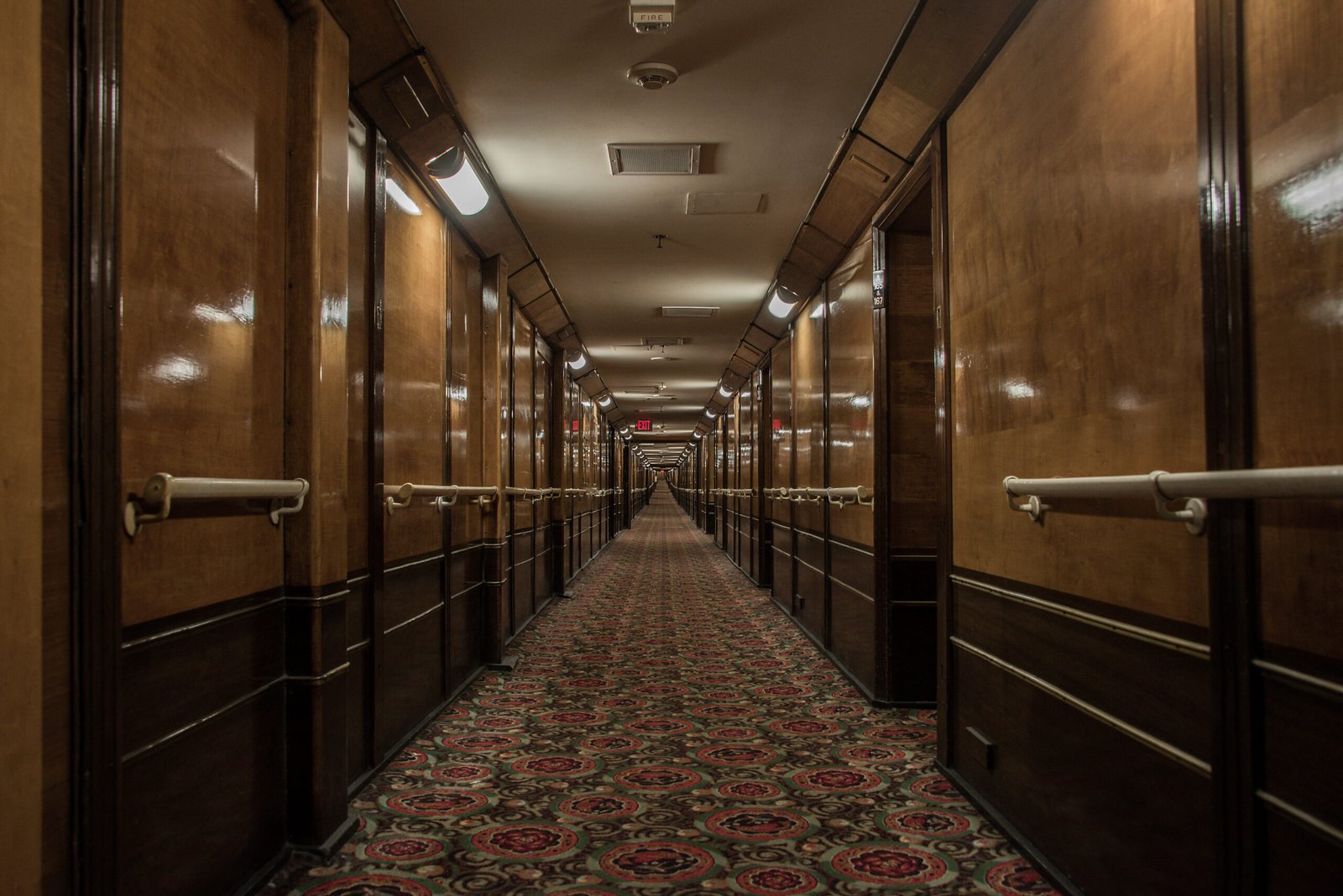
This one is real, and it’s the saddest story on the ship. On 10 July 1966, during a routine safety drill around 3:55 a.m., watertight Door 13 on D Deck crushed 18-year-old crewman John Pedder, who had been tending the bilge pump. He died at the scene or shortly after at the ship’s hospital.
Since then, witnesses — including tour guides and a night watchman whose dog froze and refused to pass the spot — report a young man in blue overalls with dark hair and a beard near Door 13, sometimes followed by a metallic clanging sound. One guide said she saw a solid, lifelike man on the stairs, waited for him at the top, and watched him vanish. The engine room and the nearby “Shaft Alley” remain the tour’s most requested stop.
What other Queen Mary ship ghosts are reported?
The HMS Curacoa collision
The darkest single event in the ship’s history. On 2 October 1942, while carrying some 15,000 US troops and zig-zagging to dodge torpedoes, the Queen Mary accidentally sliced her escort ship, HMS Curacoa, in half. The cruiser sank in minutes and 337 of her crew died. Under wartime orders, the Queen Mary could not stop to pick up survivors.
Visitors report screams and the sound of crushing metal near the bow — the ship’s most tragedy-rooted legend, and one tied to a fully documented disaster.
What other Queen Mary ship ghosts are reported?
The Lady in White
The Lady in White is seen in the Queen’s Salon (the former first-class lounge), dancing near the piano to music no one else hears. Her identity is unknown. In 1989, cleaning staff entered the Mauretania Room and saw a woman sitting on a chair in the middle of the room — when they moved to call security, she vanished.
More reported spirits
- The engine room stowaways — figures said to be wartime stowaways who died hiding below decks.
- “Grumpy” — a spirit said to growl in visitors’ ears.
- The kitchen — a cook in ship’s whites who walks in and vanishes; dishware that moves on its own.
Stories like these cluster around places tied to battlefields and tragedy everywhere — the pattern is the same: real suffering, then folklore.

What’s the rational explanation for the Queen Mary hauntings?
| The legend | What’s actually documented |
|---|---|
| Murders in Room B340 | No murders on record — the stories are acknowledged urban legend; Adamson’s 1948 death is the only documented one |
| Jackie drowned in the pool | No published death record confirms it — it’s tour tradition, not archive |
| John Pedder’s ghost at Door 13 | His death in the 1966 drill is documented; the apparition reports are witness accounts |
| Curacoa victims haunt the bow | The 1942 collision and 337 deaths are historical fact; the sounds are reported, not proven |
A fair skeptic’s answer: an old steel ship at night is a sound machine. Metal contracts and groans, ventilation hums, water laps the hull, and 346 hotel rooms of plumbing make unexplained noises. Add dim corridors, a famous reputation that primes every guest to expect something, and the very real tragedies that happened aboard — and “paranormal” experiences become almost predictable.
That doesn’t mean witnesses are lying. It means there’s a gap between “unexplained” and “supernatural” that no investigation has closed. Take the stories as folklore, not proof.
How to visit the Queen Mary: tours, hotel, and practical info
The ship is open daily as a hotel and attraction at 1126 Queens Highway, Long Beach. Here’s what you can actually do:
- Guided tours: the official lineup includes Glory Days (history), Haunted Encounters (ghost lore), and Steam & Steel (engineering). General admission runs around $45; night and paranormal tours cost more.
- Self-guided exhibits: the engine room, propeller box, bridge area, and historic exhibits are open daily, roughly 10 a.m. to 8 p.m.
- Overnight stays: the ship has about 346 staterooms. Room B340 can be booked by special request — if you dare.
- Seasonal events: the Dark Harbor Halloween event runs select nights each fall with mazes and scare zones themed on the ship’s history.
Prices, hours, and event dates change — always check the official Queen Mary FAQ and tours page before you go. Hotel guests get complimentary ship access, and parking runs about $25/day for visitors.
People also ask about the Queen Mary
How many people died on the Queen Mary?
Ghost tour guides say about 49–50 people died aboard during her 31 sailing years. Separately, 337 crew of HMS Curacoa died in 1942 when the Queen Mary accidentally struck and sank the cruiser.
Can you stay in Room B340?
Yes. The room was closed for about 30 years because of reported activity, renovated, and reopened in 2018. Guests can book it by special request through the hotel.
What was the Queen Mary used for in WWII?
Painted grey and nicknamed the “Grey Ghost,” she served as a troopship, carrying up to 15,000 troops per voyage and setting a record of 16,683 people aboard in 1943 — reportedly the most ever carried on a floating vessel.
Is the Queen Mary bigger than the Titanic?
Yes. At 81,237 gross tons and 1,019 feet, the Queen Mary was substantially larger than the Titanic (46,328 tons, 882 feet), built more than 20 years earlier.
Frequently asked questions
Is the Queen Mary ship really haunted?
Reports are abundant — voices, footsteps, apparitions — but there is no scientific proof. Treat the stories as folklore.
What is Room B340?
The ship’s most famous haunted stateroom, where passenger Walter J. Adamson died in 1948. Closed for ~30 years; reopened 2018.
Who died at Door 13?
John Pedder, 18, crushed during a 1966 safety drill. His figure is reportedly seen in the engine room.
Can you visit the Queen Mary?
Yes — daily tours, self-guided exhibits, a working hotel, and seasonal events in Long Beach, California.
More Haunted stories
- Most Haunted Places in the World: 15 to Visit
- Gettysburg Ghost Sightings: Battlefield Stories
- Is the Annabelle Doll Missing? The Truth Explained
- About NegativeVibeFix
This article presents traditional beliefs and folklore for informational purposes only, not as proven fact. If you experience persistent distress, please consult a qualified professional.